Hello Mobile Environmental Justice Champions!
🚨🚨🚨We are sending October’s newsletter a week early so you can make plans for two important Africatown meetings at the Robert Hope Community Center this week! This Tuesday, September 29, from 6-7:30pm, the Alabama Historical Commission hosts its final community engagement meeting on the Clotilda Memorial (a virtual session follows on October 7). Then this Thursday, October 1, from 5-7pm, join the Africatown Heritage Preservation Foundation to learn how you, your church, or your community group can apply for Round 2 of the Sharing the Africatown Story community project funding! All the details are below.🚨🚨🚨
Keep reading below for upcoming community events and important news!!
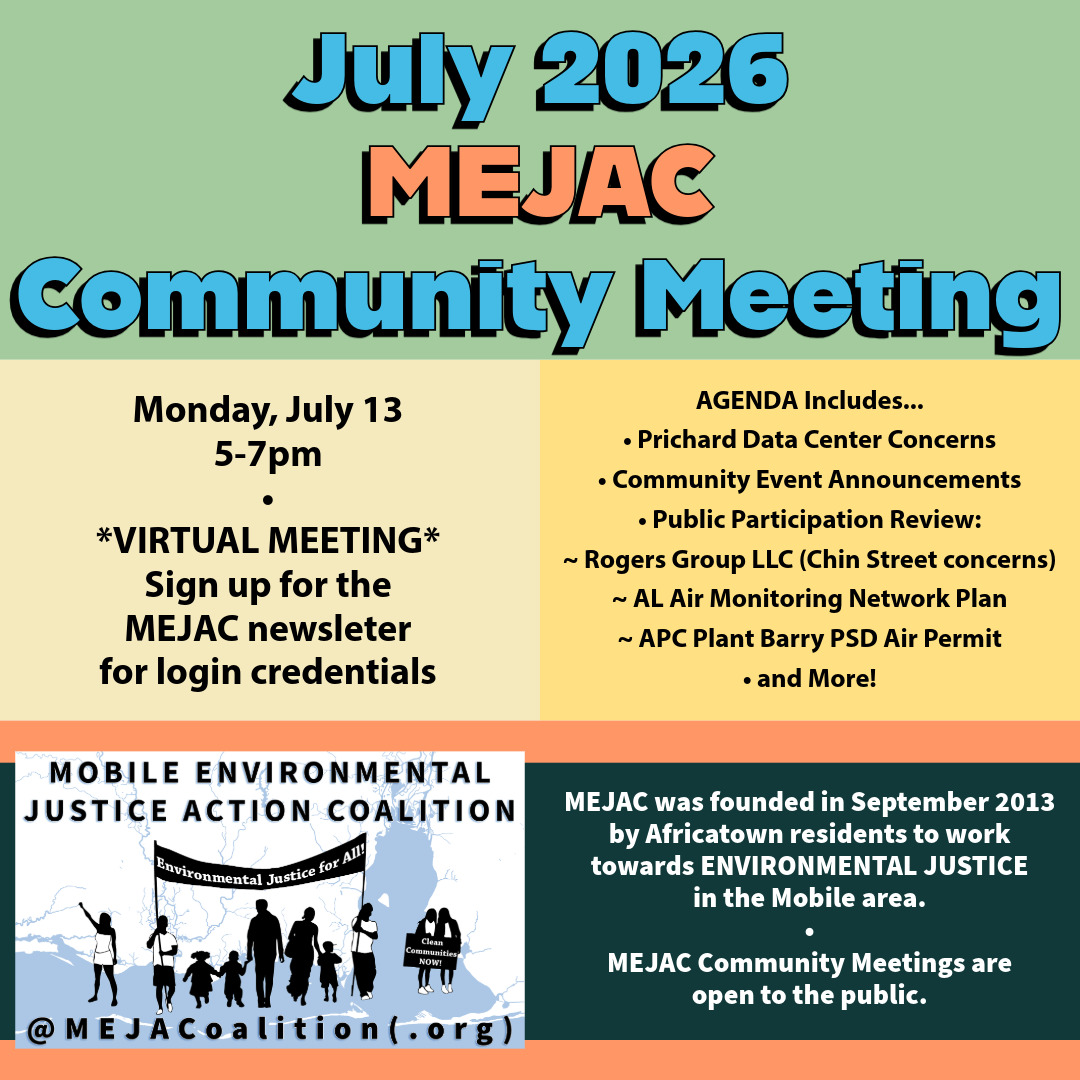
Please save the date for the next Mobile Environmental Justice Action Coalition Community Meeting:
- Monday, October 12, 2026 from 5-7pm
- Our Community Meetings are the 2nd Monday of every month and are conducted virtually (not in-person)
This month’s AGENDA includes:
- Prichard Data Center Concerns
- Community Event Announcements
- Public Participation Review:
- Borusan Pipe (Africatown) Expansion Concerns
- Eight Mile Open Burning Violation
- and More!
MEJAC Community Meetings are OPEN TO THE PUBLIC.
Meeting login credentials will be shared in a reminder email sent on the morning of our next meeting. Sign up to receive out newsletter for MEJAC Community Meeting credentials here: https://www.mejacoalition.org/get-involved/
***
THE 2026 GENERAL ELECTION IS COMING UP!
‼️Despite the racist chaos that has played out in Montgomery this year, our Alabama Secretary of State Wes Allen has ruled that the election calendar will proceed as planned. Check out the important dates below and TUNE IN if you care about your rights!
🗳️ Check your voter registration status: myinfo.alabamavotes.gov/voterview/
🗳️ Register to vote or update your registration: sos.alabama.gov/alabama-votes/voter/register-to-vote
🗳️ Check in with your family and friends to make sure they are both registered where they live AND have a plan to vote on election days!
You can find out more about the candidates in your districts and about how to vote here: www.vote.org ‼️
📞 Every Tuesday leading up to Election Day, 12pm & 6pm (via Zoom) – Stand Up Mobile and the NAACP Alabama State Conference are hosting a “Dialing for Democracy” Phone Bank to reach voters, share vital information, and strengthen our community ahead of the November 3 General Election. Join on Zoom (Meeting ID: 851 1734 0045, Passcode: Nov3). One call can make a difference! #REVIVETHEVILLAGE

🎟️ Need a perk to help Get Out The Vote for this critical election? Canvass or phone bank anytime before the game on Saturday, October 3 and earn one free ticket to the Gulf Coast Challenge!
🗳️ Friday, October 9 – Ben C. Rain High School’s “Class of 2027: Life After High School” October Series opens with a “Your Voice. Your Vote.” Voter Registration Day to help eligible seniors register to vote, check their registration status, and learn about the voting process, just ten days before the October 19 registration deadline. The school is looking for nonpartisan civic engagement and voter registration volunteers, along with Ben C. Rain alumni, local professionals, colleges, employers, skilled trades and financial literacy representatives, and community organizations, to serve as panelists, staff resource tables, or support the series as community partners. The series continues with Dress for Your Future Day on Friday, October 16 and Senior Fest on Friday, October 23. Interested? Contact Demetria Hendrix at (251) 421-0868 or ddhendrix@mcpss.com.

👀 ARE YOU AWARE that local, Mobile-area civil rights organizing is critical to how the Voting Rights Act was implemented nationwide? Look up “Mobile v Bolden” to learn more about the contributions to the legal protections that we ALL enjoy by those who came before us!

ABOUT THE NOVEMBER 3, 2026 GENERAL ELECTION:
‼️The November 3 General Election is the one that decides who actually takes office. Unlike the party primaries in August, EVERY registered voter, regardless of party, votes the same ballot on November 3 and may weigh in on every contest, from the Governor’s race to your U.S. House seat, the Public Service Commission, and more.
In Congressional District 1, the U.S. House race is between Democratic candidate Clyde Jones and Republican Jerry Carl.
Make sure you are registered and have a plan to vote!
October 19, 2026: The voter registration deadline for the November 3 General Election. You can check your status and register using the links above.
Voting absentee? To request an absentee ballot, your application must reach your county’s Absentee Election Manager by October 27 if returned by mail, or by October 29 if returned by hand. To return your completed ballot, it must be received by noon on Election Day, November 3 if mailed, or hand-delivered to the Absentee Election Manager’s office by 5 p.m. on November 2.
In Mobile County, you can vote absentee the same day you apply if you go in-person to the Mobile County Probate Court. The same deadlines above apply, and the Probate Court offices observe Monday-Friday business and federal/state holiday hours.
This is what the Alabama Election Map for US Congressional Representation looks like after the racist changes that the Alabama legislature enacted and the US Supreme Court upheld:


RECURRING MONTHLY EVENTS
- 2nd and 4th Tuesdays and Saturdays of every month – The Africatown Food Bank distributes free food aid boxes on the 2nd and 4th Tuesdays and Saturdays of every month. Volunteers to help load and distribute boxes are always welcome! Contact Rochelle Williams (plateaupacers@gmail.com) or Daphnee Frieson (daphnee.frieson@icloud.com) to let them know your interest!
***
- All month long, Tuesdays thru Saturdays, 10am-5pm – The incredible Africatown Heritage House is open to the public and is FREE to all Mobile County residents. If you haven’t already visited, please do take the time to walk through the spellbinding exhibit space and experience the power of Africatown’s history, past and present in the form of “Clotilda: The Exhibition at the Africatown Heritage House”.
***
- Tuesday, October 20, 5pm – The Africatown Redevelopment Corporation (ARC) conducts its monthly board meeting publicly at Africatown Hall (2201 Papermill Road) on the third Tuesday of every month at 5pm. For more info about the ARC: https://www.atownrc.com/

***
- Wednesday, October 21, 5-7pm – Mobile United hosts a Mobile Green Drinks “monthly happy hour for environmentally thoughtful folks” 2026 meetup series at Braided River Brewing Company, 420 St. Louis Street, Mobile, AL 36602.
October’s topic is “Conserve: Restoration, Research & Education”‼️
Networking begins @ 5 p.m.
5:45-6:15 – presentation and Q & A with the presenter
6:15-6:30 – Learn about the loads of upcoming environmental action opportunities around Mobile
7:00 – Stay for trivia fun or not!
For more info about Mobile United: https://www.mobileunited.org/

***
- Sunday, October 25, 3pm – The Mobile NAACP will conduct its General Membership meeting in person at Truevine Missionary Baptist Church, 1850 Dr Martin Luther King Jr Ave, Mobile, AL 36617. The mission of the NAACP is to achieve equity, political rights, and social inclusion by advancing policies and practices that expand human and civil rights, eliminate discrimination, and accelerate the well-being, education, and economic security of Black people and all persons of color.

***
- ONGOING – “The Africatown Experience Boat Tour” unveils the remarkable story of the Clotilda, the last known slave ship to bring enslaved Africans to the United States, by taking participants directly to the site of the scuttled ship at Twelve Mile Island in the Mobile Delta.
Private group reservations are available, contact Chiquitta Howard with Africatown Freedom Tours at 251.374.6767. This is more than a sightseeing tour: it’s a chance to reflect on history, honor the past, and celebrate the enduring spirit of a community.
For more information, including other future dates and to reserve your spot, visit: Blakeleypark.com/.

***
- ONGOING (First Saturday of every month at 9am) – Despite federal funding cuts, the STEMMing The Tide / AL-YASS program will continue as a monthly Professional Development Series for Alabama Educators, including those in the Mobile County Public School System!
Alabama educators are invited to join STEMMing The Tide and AL-YASS (Alabama Youth Action for Sustainability Summit) for a monthly professional development series focused on helping teachers embed citizen science into their classrooms and connect students with real-world environmental research. These sessions will provide practical classroom ideas, resources, and opportunities to connect with community partners along the coast and across Alabama!
We will meet virtually on the first Saturday of each month at 9:00 a.m. via Zoom. The next session is Saturday, October 3.
To stay connected or learn more, please reach out to klanier@uab.edu or AlabamaYAS@gmail.com. You can also visit the STEMMing The Tide website at https://stemmingthetide.weebly.com/.

***
UPCOMING SPECIAL EVENTS
& UNIQUE OPPORTUNITIES
- Tuesday, September 29, 6-7:30pm (in person) & Wednesday, October 7, 6-7:30pm (virtual) – The Clotilda Memorial: Final Community Engagement Meetings
The Alabama Historical Commission will host the last of its community engagement meetings on the Clotilda Memorial honoring the 110 African captives trafficked to the United States aboard the Clotilda. Come see how community voices helped shape the memorial’s Request for Proposals (RFP) and hear the latest project news, including results from the Request for Qualifications, which drew 206 artists from 34 U.S. states and 20 countries. Several local members of the memorial selection jury will share their perspectives, and Stantec will give an update on data collection for the next phase of preserving the Clotilda.The in-person meeting is this Tuesday, September 29, from 6-7:30pm at the Robert Hope Community Center, 850 Edwards St, Mobile, AL 36610 (RSVP here; encouraged but not required). Can’t make it in person? Join the virtual session on Wednesday, October 7, from 6-7:30pm on Zoom (RSVP here). Both meetings are free and open to the public.
Selected artists and design teams will develop site-specific proposals in the next phase, each receiving a $2,000 honorarium for their designs, and the total project budget is $2,000,000. The memorial is being developed in collaboration with Clotilda descendants, Africatown residents, and connected diasporic communities, with the goal of realizing it by 2028. Learn more at TheClotildaMemorial.info.

***
- Thursday, October 1, 5-7pm – YOU’RE INVITED! The Africatown Heritage Preservation Foundation will host a community meeting to launch Round 2 of its Sharing the Africatown Story Community Impact Project Funding at the Robert Hope Community Center, 850 Edwards St, Mobile, AL 36610. Come learn about the funding opportunity and bring your community project ideas! Food will be served, and there will be door prizes.
Individuals, nonprofit organizations, religious organizations, community groups, and partnerships serving Africatown are eligible. Projects must benefit the Africatown communities of Magazine Point, Lewis Quarters, Plateau, Happy Hill, and Kelley Hills, contribute to sharing the Africatown story, and create a resource that is freely accessible to the public, such as arts, crafts and murals, green spaces, historical markers, cultural preservation, and community improvement. Applications will be available on site, and the application deadline is Friday, October 23, 2026.
In Round 1, the Foundation awarded 13 grants totaling $55,000 for 2026 projects, ranging from historical markers and a memorial garden for Africatown’s military veterans to a church museum, a seed library, gardens that grow healthy food for seniors, the Africatown Quilters, and a cookbook of Africatown recipes. Another $55,000 is available in this round. For more information, contact info@africatownhpf.org or visit www.africatownhpf.org.

***
- LAST CHANCE! Reimbursement Deadline: This Wednesday, September 30, 2026 – Is Your Home Rain Ready? You can get reimbursed for Rain Barrels & Rain Gardens in Alabama. Auburn University’s Ginn School of Engineering, the Alabama Department of Environmental Management, the City of Mobile, and Naturally Mobile have partnered on Rain Ready Alabama, a rebate program that reimburses Alabama residents and businesses for installing rain barrels or creating rain gardens on their property. Simple stormwater upgrades like these can keep polluted runoff out of Mobile Bay and its tributaries, ease pressure on Mobile’s overburdened sewer system, and build household-level resilience against the heavy rains we see year-round. Applying is a three-step process: check your eligibility online, fill out the application, then submit receipts through the reimbursement form after you buy or build. Learn more and apply at rainready.auburn.edu.

***
- Thursday, October 1, 4–7pm (ribbon cutting at 4:30pm) – The limestone rock distributor in Magazine Point, Rogers Group, will host an Open House at its facility at 1920 Bay Bridge Cutoff Road, Mobile, AL 36610, to see recent upgrades that the company says will reduce dump-truck traffic, noise, and dust for nearby neighbors, including a new High-Capacity Hybrid Material Handler for offloading barges and a series of overland conveyors. Attendees will be treated to a fried fish dinner, handouts, and giveaways, and can talk directly with Rogers Group representatives about how the upgrades will affect the community. Please wear flat-soled shoes and dress comfortably for the weather.

***
- Saturday, October 3, 7am (bus pickup) – Africatown Freedom Tours invites you on an Africatown Trip to Gee’s Bend to experience the beauty, history, and legacy of Gee’s Bend and its world-renowned quilters. The bus leaves the Robert Hope Community Center, 850 Edwards St, Mobile, AL 36610, at 7am, with a breakfast stop at McDonald’s, arrives in Gee’s Bend at 10:30am, and departs for Mobile at 1:30pm. The cost is $40 per person, and registration and payment must be completed two days in advance (by Thursday, October 1). For more information, call Keta at 251.508.6807.

***
- Saturday, October 3, 7:30am – Kick off Breast Cancer Awareness Month with the Africatown Plateau-Pacers and MercyLife at Pacing for a Cure, walking laps around John Kidd Park. Drop $10 in the bucket for breast cancer, with all proceeds going to the Breast Cancer Awareness Foundation. Together we walk, together we win! #HealthIsWealth

***
- Thursday, October 8, 5:30-6:30pm – District 2 Councilwoman Dr. Samantha Ingram will host an Africatown community meeting with Shonnda Smith, Executive Director of Public Works for the City of Mobile, at the Robert Hope Community Center, 850 Edwards St, Mobile, AL 36610. The meeting is part of the Councilwoman’s monthly updates on the City’s planning for Africatown’s revitalization (see the Africatown Revitalization item below).

***
- Saturday, October 10, 8:30-10:30am – Join your neighbors for a morning of community clean-up at the Africatown Clean-Up, starting from Africatown Hall, 2201 Paper Mill Road, Mobile, AL 36610. It’s a rain or shine event, and supplies, water, and snacks will be provided. To register or ask questions, email carrie@bloombusinessservices.co or scan the QR code on the flyer.

***
- Saturday, October 10, 10am – We Stand Up! Stand Up Mobile and the Mobile Alabama Africatown Drummers (MAAD) present a Benin-Africatown civic engagement and voter mobilization event at the Robert Hope Community Center, 850 Edwards St, Mobile, AL 36610, featuring Yewhe Yeton, a leading Benin hip hop artist, live in Africatown. The award-winning Beninese musician will give a musical lecture-performance, “Voices of Resistance,” in honor of Africatown’s rich legacy of resilience, along with traditional Benin drumming workshops with MAAD. Our history, our community, our vote, our power!

***
- Sunday, November 1, 2026, 3pm – The Mobile NAACP will host its 2026 Freedom Fund Awards Banquet with the theme “The Ballot Is Our Power: Reclaiming Democracy in Challenging Times” at Calirojae on Dauphin Island Parkway, just two days before Election Day. The keynote speaker is Mobile County Commissioner Merceria Ludgood. Individual tickets are $75 and reserved tables of 8 are $600. RSVP early by emailing mobilealnaacp@gmail.com. Sponsorships and souvenir-booklet ads are also available (ad submission deadline this Thursday, October 1).

***
- UNIQUE OPPORTUNITY – Save the Date: February 25-28, 2027 – The All Things Africatown Community-Engaged Conference is seeking presentations, workshops, performances, and dialogues that spotlight Africatown and other Black descendant communities fighting for cultural preservation and environmental justice. Whether you are a scholar, artist, organizer, student, or community leader, the conference wants your voice on Black ecological knowledge, community-led storytelling, heritage preservation, environmental justice, and collaborative research. Submit a proposal here. The conference is presented by the University of South Alabama with Penn State, Oberlin College, and the Africatown Heritage Preservation Foundation, in conjunction with the All Things Africatown Festival. Questions can go to Conference Chair Dr. Kern M. Jackson at allthingsafricatownconference@southalabama.edu.
***
- ONGOING – Africatown Welcome Center: Share Your Africatown Story
The Africatown Welcome Center, a new gateway to the community that is tentatively slated to open in late December 2026 or early January 2027, will host exhibits telling Africatown’s story, and the City of Mobile is inviting the community to help fill those exhibits. On September 1, the Mobile City Council approved a contract of up to $240,954.15 with Watermark Design Group to design and coordinate the Welcome Center’s museum exhibits.Residents, descendants, and organizations are invited to submit content that could include photos, documents, artifacts, oral histories, and other materials relevant to Africatown’s history and living culture for consideration in future Welcome Center exhibits.
If you have exhibit suggestions or content to contribute, email AfricatownWelcomeCenter@cityofmobile.gov as soon as possible for consideration.
The Mobile City Council has now approved the FY2027 City of Mobile budget, which continues to support this work. As proposed, the budget carried a $757,345 line item committed specifically to the Africatown Welcome Center, which is a standalone allocation rather than money folded into a general public-works fund.
For some numbers fun: the City of Mobile’s General Fund budget is about $404 million; its Capital Improvement Program is $32 million (roughly 7.9% of the General Fund), of which each of the seven council districts receives $4 million. Seen that way, the Welcome Center’s dedicated $757,345 is about 0.19% of the entire General Fund, a fraction of a slice in percentages, but an investment in Africatown’s future nonetheless.
Photo: City of Mobile

***
- ONGOING – Africatown Revitalization: Monthly Updates from Councilwoman Ingram
District 2 Councilwoman Dr. Samantha Ingram has begun sending monthly updates on the City’s planning for Africatown’s revitalization. Her September update shares that on August 25, the City Council approved an agreement with Lyvve Investment Group, LLC, to support project management, community engagement, and partnership building for Africatown, including monthly project updates and outreach to cultural organizations. She and Mobile County Commissioner Merceria Ludgood have also finalized a Request for Proposals to hire a consultant to update the 2016 Africatown Neighborhood Plan into a Master Plan to guide future development (see AL.com’s September 21 story in the news below).A plan for Africatown’s future should be shaped by the people of Africatown, so watch for chances to weigh in! Councilwoman Ingram’s office can be reached at 251-208-7608 or samantha.ingram@cityofmobile.gov.
***
- ONGOING – Our Mother of Mercy Catholic Church Turns 100
For a century, Our Mother of Mercy Catholic Church has been a pillar of faith, fellowship, and service in Africatown. The parish is celebrating its 100th anniversary and working toward a $100,000 anniversary fundraising goal to keep this historic church serving the community for generations to come. Fittingly, a new historical marker for the church is among the 13 projects funded in Round 1 of the Africatown Heritage Preservation Foundation’s Sharing the Africatown Story initiative. Learn how you can participate in and support the celebration at ourmotherofmercymobile.org.
***
- ONGOING – Disaster Preparedness Survey: Help Shape Mobile’s Resilience Planning
The Community Foundation of South Alabama and the University of South Alabama are conducting a Disaster Preparedness Survey of Mobile residents to identify the strengths and needs of our community’s disaster response and to inform new resilience initiatives for the City of Mobile. Given the flooding, hurricane, and industrial-hazard exposures that environmental justice communities know firsthand, resident input is exactly what researchers need to make the resulting plans reflect frontline realities rather than agency assumptions.To participate, scan the QR code on the survey flyer or follow this link. Participants will enter a monthly drawing for a $200 gift card. Questions about your rights as a research participant can be directed to the USA Institutional Review Board at 251-460-6308 (or toll-free 866-511-6509), or by email at ahotard@southalabama.edu.

***

📚 05/26/26, MEJACoalition.org – Doing it Differently: Hard Earned Lessons from Engaging with a Proposed AI Data Center on the Africatown side of Prichard – This is a deep dive into the proposed AI Data Center on the Africatown side of Prichard presented by MEJAC after many, many hours of deliberations, Africatown community consultation, and an actual tour of the company’s other data centers in Atlanta.
📚 06/12/26 – AL.com – South Alabama residents loudly reject proposed data center: ‘Community has spoken’ – “Another south Alabama community is saying no to a new data center. On Thursday, representatives with Edged Energy, a data technology company, held a town hall with residents and Prichard’s leadership to discuss a proposed data center in the city. Around 200 people attended the meeting, despite no air conditioning in the Prichard City Hall auditorium. And the heat almost certainly did not help calm residents who are fiercely opposed to the data center. “It’s hot, and people are irritated,” said Ramsey Sprague, president of the Mobile Environmental Justice Action Coalition, who attended the meeting. “It’s hard to absorb new information when people are yelling and shouting.”
📚 07/13/26 – InsideClimateNews.org – Alabama data center non-disclosure agreements raise transparency concerns – “After months of resistance, officials in a historic suburb of Birmingham have released a non-disclosure agreement between city leaders and developers of a hyperscale data center.
The release of the agreement came after environmental groups threatened to sue Bessemer over its unwillingness to share public documents related to the proposed construction of a 4.5 million-square-foot hyperscale data center on the rural southwest edge of the city of 25,000.
The text of the non-disclosure agreement, originally effective in February 2025 and amended in February 2026, prohibits “the City of Bessemer” from publicly releasing information related to Project Marvel in any of six categories, including information about the project’s developers, site plans, and reports or studies or any “other information that would reasonably be considered non-public.”
📚 07/16/26 – TennesseeLookout.com – EPA administrator calls statewide data center moratorium a ‘cop-out’ – EPA Administrator Lee Zeldin dismissed statewide data-center moratoriums as a “cop-out,” drawing pushback from state officials and community groups.
📚 07/30/26 – AL.com – Residents seek accountability, written guarantees on $6 billion data center – “As plans move forward for a $6 billion data center expected to begin construction in north Mobile County this fall, about 50 residents gathered at a community center in Mt. Vernon on Monday alongside local politicians and political candidates, seeking answers and assurances that one of South Alabama’s largest proposed developments will be built responsibly.
The gathering also brought into focus a frustration that has become central to opposition surrounding the project in unincorporated Mobile County: Why aren’t elected officials doing more to protect residents who feel they have little say over what happens next?
“They are your representatives and we elect them,” said Gena Daniels, a 20-year Mt. Vernon resident who said one of the community’s biggest concerns is that no local government body has the authority to tell Beacon Data Centers “No” or issue a moratorium to slow data center projects.”
📚 08/04/26 – AlabamaReflector.com – Alabama Public Service Commission approves solar project supporting data center – The PSC greenlit a new solar project tied to data-center load, a concrete example of generation being built to serve the data centers residents are scrutinizing in Macon and Bullock Counties.
📚 08/04/26 – Reuters.com – Trump’s EPA was wrong to terminate billions in climate grants, US appeals court rules – A federal appeals court upheld an injunction protecting roughly $20 billion in clean-energy and environmental-justice grants that Trump’s EPA tried to freeze. Millions of dollars in this grant program was approved for Mobile County Environmental Justice communities.
📚 08/11/26 – MyNBC15.com – New Alabama law at odds with Army Corps’ 20-year dredging plan – Alabama’s new beneficial-use dredging law could clash with the Corps’ long-term Mobile Bay maintenance plan, setting up the next phase of the bay fight.
📚 08/27/26 – WDHN.com – TSU rapid response team tours Shiloh community amid mitigation project construction – Texas Southern University’s Bullard Center rapid-response team toured the flood-plagued Shiloh community near Elba as ALDOT began mitigation work on flooding that began in 2018, when a Highway 84 expansion left the Black neighborhood sitting below the road.
📚 08/31/26 – MyNBC15.com – Prichard questions validity of permit issued before data center moratorium – Prichard moved to void the building permit issued July 30 for the Edged data center beside Africatown, and to refund the developer’s $224,000 in fees, days before the city’s Aug. 4 moratorium.
📚 09/01/26 – AlabamaReflector.com – Alabama Public Service Commission lowers rate of return for energy company – The PSC cut Spire’s guaranteed profit but let it raise the fixed monthly charge, a live example of how PSC decisions shape residential utility bills.
📚 09/07/26 – ALReporter.com – Mobile Baykeeper relaunches coastal Alabama water testing program – Our friends at Mobile Baykeeper have their water testing back up and running, so check before you get in the water! “Ater a five-month pause, Mobile Baykeeper announced Friday that its Swim Where It’s Monitored, or SWIM, water quality monitoring program is relaunching as the CrowderGulf SWIM program.”
📚 09/08/26 – Fox10TV.com – Absentee voting in Alabama begins amid legal battle over USPS mail ballot rules – “The first absentee ballots in Alabama will be sent out on Wednesday, Sept. 9, according to the Alabama Secretary of State’s office. The start of midterm voting kicks off amid an ongoing legal battle in Washington D.C., which could impact mail-in ballots across the country. The only mail-in ballots that are sent out in Alabama are absentee ballots. There is a set list of what makes someone eligible to get one, such as being away at college, being an active-duty military member or being a caregiver. Shalela Dowdy, senior field organizer with the Alabama NAACP said the organization disagrees with an executive order requiring states to supply the U.S. Postal Service with lists of mail-ballot recipients.”
📚 09/08/26 – ABC3340.com – Tarrant Approves 12-Month Moratorium on Data Centers – “The City of Tarrant is the latest Alabama community to pause potential data center development. Tarrant city officials approved a 12-month moratorium on data centers, with Mayor Tracie Threadford saying the decision was made out of caution as the city prepares for potential future development. Threadford said no potential data center developers have approached the city at this time. However, she noted that several buildings currently for sale in Tarrant could potentially fit the needs of a smaller data center project.”
📚 09/08/26 – AlabamaReflector.com – Tommy Tuberville’s data center plan: Some good ideas, a lot of fatal flaws – “Tommy Tuberville’s data center plan has some good ideas. The problem is that they’re good ideas for long-term constitutional reform, not the pressing challenges these large-scale facilities pose. And even if he’s serious about giving communities the power to say no to data centers, his proposal lacks a key requirement to make those objections meaningful.”
📚 09/08/26 – AL.com – Alabama’s anti-DEI law in crosshairs: How Florida case could pave the way for dismantling it – “Two years after Alabama passed an anti-DEI law that bans the teaching of “divisive concepts,” the legal battle to dismantle it continues. And a federal court’s decision to strike down part of a similar law in Florida could foreshadow what’s to come in Alabama. ACLU senior staff attorney Leah Watson represented professors and students who sued to strike down Florida’s law. She told AL.com her clients’ win could have an impact on Alabama’s law, also known as SB 129.”
📚 09/09/26 – Fox10TV.com – Foley approves 6-month data center moratorium – “The Foley City Council has approved a temporary moratorium on applications for data centers. The moratorium will last six months. The city says no data centers have been proposed in Foley at this time. The city says the moratorium will allow time to study regulations in case a data center application is filed in the future.”
📚 09/09/26 – FloodlightNews.org – America’s air monitors are disappearing. So is your power to expose polluters. – “Across much of the U.S., people have little way to know when the air they breathe turns dangerous. Over recent decades, federal funding for public air monitoring has declined, the number of monitors has fallen, and much of the remaining equipment is aging or located far from major polluters. Now, the stakes are rising: Wildfire smoke is reaching more communities, data centers are adding pollution, and climate-driven heat waves are worsening ozone levels. The Trump administration, meanwhile, has delayed and rolled back requirements meant to hold companies accountable for their emissions.”
📚 09/09/26 – SELC.org – Communities face greater flood risk if HUD rolls back protections – From our friends at SELC: “The current administration in DC continues to ignore community needs and commonsense resilience solutions, with its attempt to roll back a 2024 rule designed to reduce flood risk for affordable housing. The rule in question implemented the Federal Flood Risk Management Standard (known as FFRMS) that required federally assisted housing and other infrastructure to be built to withstand flood risk throughout its expected useful life. The Department of Housing and Urban Development (HUD) published the proposal to roll back the rule in July and the comment period closed on September 8.“
📚 09/09/26 – AL.com – ‘No authority’: Helpless on data centers, Alabama counties caution against industry-specific zoning – “Residents of a tiny area outside Somerville became alarmed this spring when they learned a company planned to build a bitcoin data mining operation on 15 acres in their midst. They feared the VoltCore project would destroy the rural and quiet character of their community. Hundreds of residents signed petitions and asked the Morgan County Commission for help. Commissioners responded by imposing a one-year moratorium on data centers, bitcoin mining facilities, or other similar projects. But those were hollow words. County commissions don’t have the power to enforce such moratoriums. “
📚 09/10/26 – Fox10TV.com – Prichard mayor’s budget draws mostly praise, but also worries over revenue projections – Worth noticing: the projected jump in Prichard’s sales tax revenue depends on a data center that has not been built. “Most speakers at a public hearing on the proposed budget expressed support for the spending plan, but some expressed concern that the revenue projections are too rosy. Mayor Carletta Davis’ proposed budget, her first since winning election last year, anticipates spending $21.88 million. It includes money for pay raises, a proposed $5 increase in the $15 monthly municipal fee and new gasoline tax of 1 cent per gallon.”
📚 09/10/26 – Fox10TV.com – Developer of proposed data center threatens Prichard with litigation – ‼️This is the Edged Energy data center proposed on the Africatown side of Prichard, and the developer’s attorney is now threatening to fill the wetlands and build if the city requires more review. “A stalled data center project could be headed to court. A lawyer for Edged Energy sent a pointedly worded letter to Prichard City Council President Traci Hale last week, threatening a lawsuit if the city attempts to block a building permit it issued for the construction of a data center on Telegraph Road. Once hailed as a project that could deposit millions of desperately needed dollars in the city’s coffers, the relationship has turned acrimonious. City council members spent more than two hours behind closed doors Thursday, discussing the data center and three other issues that fall under an exception to Alabama’s open meetings law. When they returned to the public meeting, council members voted unanimously to refer the matter to Council Attorney Moshae Donald Walker. Doug Anderson, the attorney representing Edged Energy, suggested that he would not hesitate to go to court.”
📚 09/10/26 – ALReporter.com – SPLC accuses ALDOT of illegal covenants in Shiloh – “The Southern Poverty Law Center filed a complaint against the Alabama Department of Transportation on Wednesday, alleging the department used unconstitutional and restrictive covenants involving property owners in the Shiloh community. Beginning in 2017, ALDOT received partial federal funding from the Federal Highway Administration to widen U.S. Route 84 from two lanes to four. The construction resulted in soil erosion and stormwater flooding because of drainage system failures, according to the complaint. Major flooding occurred in 2019, followed by 13 floods the next year. The most recently reported flood occurred in summer 2025.”
📚 09/10/26 – CapitalBNews.org – Federal Government Moves to Limit Public Input on Data Center Projects – 🚨Fewer public notices and comment periods on air permits means fenceline communities find out after the permit is already issued. MEJAC flagged this proposal at our September meeting.🚨
“Americans don’t agree on much, but that’s not the case when it comes to data centers. Seven in 10 Americans oppose building data centers for artificial intelligence in or near their communities. Despite this, the federal government is moving to make it easier for them to be built. And in some places, residents won’t even get the chance to raise concerns publicly or even know if a data center is coming to their neighborhoods.
The federal Environmental Protection Agency plans to scrap a federal requirement that states tell the public — and allow public comment — before approving air-pollution permits for industrial facilities. That includes the data centers rising across the country, as well as the power plants built to feed their enormous appetite for electricity.”
📚 09/10/26 – SELC.org – Your right to hold polluters accountable is under attack – Citizen suits are one of the few tools communities have when regulators will not act. Our friends at SELC explain what is at stake: “No one is above the law. This principle is the very foundation of America and it is fundamental to our nation’s bedrock environmental laws.
When a corporation illegally dumps cancer-causing chemicals into our waterways, pollutes our air, or destroys critical wildlife habitat, everyday people have the right to fight back in court.
These lawsuits, known as citizen suits, are a powerful tool communities use to protect their health, their families, and the places they love when government agencies fail them.
Now, that right is under attack.”
📚 09/10/26 – AlabamaReflector.com – Suit challenges Trump administration move to allow some ICE presence at polling places – “Latino advocacy groups and voting rights organizations Thursday filed a suit in federal court challenging the Trump administration’s policy of allowing U.S. Immigration and Customs Enforcement officers to enter polling locations in certain circumstances to conduct immigration enforcement during the 2026 midterm elections.
The suit in the District Court for the District of Columbia argues that Homeland Security Secretary Markwayne Mullin’s recent comments that ICE agents would be at polling locations for the purpose of immigration enforcement violates federal law that prohibits federal “armed men” at election sites.”
📚 09/10/26 – AL.com – Data center company sued again in Birmingham – by a Regions Bank shareholder – “A Regions Bank shareholder is suing bank officials as well as AI company Nebius Inc. over the sale of the property slated for a $36 billion data center in Birmingham.
James Anderson is accusing Nebius of defrauding the Birmingham-based bank of $66.3 million when the company and its affiliates bought the Oxmoor Valley property, per the lawsuit. He’s also accusing Regions Bank officials of a “breach of fiduciary duty” in executing the real estate transaction.”
📚 09/11/26 – InsideClimateNews.org – Data Center Boom Brings Health Hazards, Former EPA Officials Warn – “The artificial intelligence boom poses serious health risks while the Trump administration is dismantling crucial safeguards designed to protect the public, according to former officials at the federal agency responsible for environmental protection.
A report released Thursday by the Environmental Protection Network—an organization led by former Environmental Protection Agency staffers—outlines hazards from the rapid rise of data centers. Among those is pollution from increased power demand, which is linked to asthma, cancer, neurological harm and heart and lung disease.”
📚 09/11/26 – MississippiFreePress.org – Mississippians Have No Constitutional Right to Clean Drinking Water, Court Rules – “Americans do not have a constitutional right to clean drinking water, the 5th U.S. Circuit Court of Appeals ruled on Sept. 4. The decision follows a lawsuit that alleged the City of Jackson’s indifference and negligence with its water system led to several of the plaintiff’s children being diagnosed with lead poisoning after exposure to contaminated water.
“These deprivations, while grievous, do not infringe upon any deeply rooted constitutional right,” Judge Kurt D. Engelhardt said in the accompanying opinion.
The case before the court, Sterling v. The City of Jackson, was filed in 2022 by Jackson resident Priscilla Sterling alongside three other residents amidst the Jackson Water Crisis.”
📚 09/11/26 – ALReporter.com – Race rater narrows GOP edge in Alabama’s 2nd Congressional District – “A nonpartisan race rater shifted its projection for Alabama’s 2nd Congressional District on Thursday, projecting a smaller Republican advantage than previously reported.
Sabato’s Crystal Ball analysis shifted its rating for CD2 from “Likely Republican” to “Leans Republican.”
The district’s race between incumbent Representative Shomari Figures, D-Alabama, and Republican nominee and former Alabama Representative Rhett Marques has become a priority for national Republicans after the Alabama Legislature redrew the district in Republicans’ favor during its 2026 special session.”
📚 09/13/26 – InsideClimateNews.org – How Alabama Power Escaped a Push for Tighter Regulation With Record Profits Intact – Wired For Profit Part 6: “Mack Butler insists he’s not angry about how it all turned out.
“That’s just how it goes in the Legislature sometimes,” he says, leaning back behind the desk at his office in Rainbow City, a suburb of Gadsden that sits along the Coosa River in northeast Alabama.
Butler, a Republican representing bright-red District 28 in the Alabama Legislature, had gotten remarkably close during the 2026 legislative session to passing what likely would have been the toughest utility reform bill Alabama has ever seen.”
📚 09/13/26 – InsideClimateNews.org – The Alabama Legislature Was on a Collision Course With Alabama Power. Then Came Spring Break. – Wired For Profit Part 7: “When Alabama lawmakers left for spring break during the 2026 legislative session, many of them knew something had to be done. Landmark legislation curbing the profits of the state’s influential electric utility, Alabama Power, had unanimously passed the House.
Even in the lower chamber, many of the Republicans who had supported the bill were searching for a way out of their vote.
So on March 30, the night before the Legislature returned from spring break, Sen. Sam Givhan, R-Huntsville, filed a substitute version of HB 475, the major reform bill that would have transformed the way Alabama sets electric rates.
It had consumed lawmakers and Alabama Power for months.”
📚 09/14/26 – SELC.org – EPA Repeals Power Plant rules as Southern utilities plan to build 43,000 MWs of new gas – Our friends at SELC connect the dots to the gas buildout planned by Southern utilities, including Alabama Power: “As the Southeast is currently facing a massive gas build-out, the Environmental Protection Agency (EPA) released a final rule today, repealing carbon pollution standards for fossil-fueled power plants, a main contributor to climate change. At the same time, EPA also released a proposed rule purporting to limit EPA’s authority to regulate and protect the public from climate pollution from power plants.
Southern monopoly utilities are currently planning to build 45,000 MWs of new gas to meet projected electricity demand, mainly from data centers. By removing these rules, the EPA is opening the floodgates for Southern polluters with little to no oversight.
Burning methane gas releases carbon dioxide, the primary driver of climate change. Following transportation, power plants are the nation’s largest source of planet-warming pollution.”
📚 09/15/26 – ALReporter.com – Conservative anti-data center group brings bus tour to Bessemer – “On Sunday, September 13, Humans First, a self-described “grassroots conservative organization fighting for an America First AI policy,” brought its nationwide bus tour to Bessemer, where the group held a news conference warning about the dangers of unregulated AI data center construction.”
📚 09/15/26 – ALReporter.com – Alabama sample ballots now available for Nov. 3 General Election – ‼️Look up your sample ballot before November 3!
📚 09/16/26 – WDHN.com – Shiloh community residents claim flooding shortly after ALDOT’s mitigation project – “After the State Department of Transportation wrapped up its flooding mitigation project for the Shiloh community at the end of August, residents claim about two weeks later the nightmare returned as they saw flooding after nearly 30 minutes to an hour of rain last weekend.
“It’s like deja vu all over again,” Shiloh resident Timothy Williams said. “That water came through and washed away the soil and it brought back memories. We said it’s not a fix we asked them and FHWA (Federal Highway Administration) for a fix and pipe the water out, but they gave us ditches and it has no where to go but over back onto our property.””
📚 09/18/26 – ALReporter.com – Ratepayer Protection Act stalls in US Senate – “. . .Senator Martin Heinrich, D-New Mexico, objected, saying the legislation does not go far enough because it asks states to consider requiring data centers to pay for new grid infrastructure rather than requiring them to do so.
The Senate action came a day after the House passed the bill 417-3. The legislation would require state public utility commissions to consider standards for large electricity users, including data centers, that would account for the incremental costs of new power generation and transmission infrastructure needed to serve those facilities.”
📚 09/18/26 – SELC.org – Court Strikes Down Trump’s EPA Cancellation of $7 Billion Solar for All Program – “A federal judge has ruled that the Environmental Protection Agency unlawfully canceled the $7 billion Solar for All program, striking down the agency’s decision to end a nationwide program designed to lower electricity bills and bring affordable solar power to families and communities across the country.
“The court ruled the Trump Administration never should have terminated Solar for All because Congress intended it to continue, and EPA broke the law when it killed the program and pocketed the money,” said Southern Environmental Law Center, Senior Attorney Nick Torrey. “Electricity bills are skyrocketing, so low-cost solar projects — which guarantee big savings — are needed now more than ever. Today’s victory means EPA must stop sitting on the $7 billion in funding for this program and start getting it out into communities to provide hardworking American families much-needed relief.”
📚 09/18/26 – WordInBlack.com – $2.8 Billion for Climate Justice Is Stuck in Legal Limbo – “In the early days of the Trump 2.0 administration, as federal departments slashed programs under DOGE, the Environmental Protection Agency turned its eye to the $2.8 billion Environmental and Climate Justice Block Grant Program as a potential target for budget cuts.
Funded under former President Joe Biden through the Inflation Reduction Act, the program was intended to help under-resourced communities on the front lines of climate change. The Trump-era EPA quickly cut the block grant program entirely.
Then, when it shut down the Office of Environmental Justice and External Civil Rights, the EPA fired all staff members who managed the grants. Environmental groups sued.”
📚 09/18/26 – Fox10TV.com – In reversal, ALDOT says tolls on new Mobile River bridge automatically will rise annually – “Alabama transportation officials and local leaders have promised for years that tolls on a new bridge over the Mobile River would never rise.
Documents submitted in support of the sale of revenue bonds, though, lay out a schedule of automatic yearly increases. Tolls “shall be automatically adjusted annually on January 1 of each year,” those documents state.
Tony Harris, a spokesman for the Alabama Department of Transportation, confirmed that the tolling plan had changed. He said it is the only way the state can pay back the money it is borrowing for what will be the most expensive infrastructure project in the state’s history.
That provision took Eastern Shore Metropolitan Planning Organization Chairman Jack Burrell by surprise.”
📚 09/19/26 – AL.com – Tuberville calls for 4-year freeze on electricity rates in Alabama – They’re already TOO HIGH THO!!
📚 09/19/26 – AlabamaReflector.com – With vote-by-mail court fight settled, attention shifts to protections at the polls – “Voting rights groups and Democratic officials are looking to defend against what they see as possible election interference from the Trump administration ahead of the upcoming midterm elections, now that they’ve won a major battle over mail ballots.
Common Cause, a nonpartisan pro-democracy organization, announced a “voter protection” campaign Thursday that would place thousands of volunteers at polling sites in 25 states.
The initiative is designed to counter potential administration moves to intimidate voters, such as ordering troops or law enforcement officers to polling places.”
📚 09/21/26 – AL.com – Data center backlash: At least 17 Alabama cities pause development – “At least 17 cities across Alabama have temporary bans in place on new data centers – some of them rushing to limit the development before any companies express interest.
Tarrant, a town of about 6,000 just north of Birmingham, will take its yearlong moratorium period to study data centers and train its planning commission on the industry, said Mayor Tracie Threadford.”
📚 09/21/26 – SELC.org – We’re suing over OpenAI’s secret $20B data center – Sound familiar? Our friends at SELC are taking on the same kind of data center secrecy that Alabamians have been fighting in Bessemer: “Local officials worked in secret for months on a $20 billion data center deal with OpenAI. SELC is suing on behalf of local partners and residents.
Effingham County, located just outside of Savannah, Georgia, is known for its small-town charm, blackwater paddling, and ancient cypress trees. This community — like all our communities — has a right to know about and engage in local projects that affect them.
This is especially true for a colossal 4.4 million square foot data center campus that would be less than 1,000 feet from homes and next to two elementary schools. “
📚 09/21/26 – AL.com – Clotilda changed Africatown. Now officials want a new roadmap for its future – ‼️Councilwoman Ingram and Commissioner Ludgood have finalized the RFP to hire a consultant to update the 2016 Africatown Neighborhood Plan (see our Africatown Revitalization item above). This is Africatown’s plan, so be ready to weigh in! “A decade ago, Africatown’s future was largely centered on neighborhood revitalization. Then came the discovery of the Clotilda.
The identification of the last known slave ship to bring captive Africans to the United States transformed the historic Mobile community from a largely overlooked neighborhood bordering industrial development into an international destination for Black history and cultural tourism.
Since then, a museum has opened, a new park has also opened, honoring the Clotilda’s legacy, festivals have drawn visitors, housing redevelopment efforts have gained momentum, and a new Welcome Center is nearing completion.
But the blueprint guiding the community’s future predates all of that.”
📚 09/22/26 – AL.com – Alabama mayor who signed data center NDA loses seat to challenger in runoff election – Data centers are deciding elections now. “An Alabama mayor who backed a controversial hyperscale data center and signed non-disclosure agreements lost his seat in a runoff election on Tuesday night. Bessemer Mayor Kenneth Gulley, who was vying for a fifth term, lost his seat to Louise Alexander, according to election results posted at city hall shortly before 9 p.m.”
📚 09/22/26 – AL.com – Everything you need to know about the $4.15 billion I-10 project’s tolls – “The Alabama Department of Transportation says tolling is essential to finance the $4.15 billion first phase of the Mobile River Bridge and Bayway project, a price tag that exceeds Alabama’s annual transportation budget and has continued to grow because of construction inflation.
The project includes a new six-lane, 215-foot-tall, cable-stayed bridge over the Moble River, a widening of the existing Bayway from four lanes to six lanes through restriping, and related improvements designed to reduce congestion, improve freight movement and provide a direct interstate route for hazardous-material trucks that cannot use the Wallace Tunnel.
Construction is expected to begin this year and continue through about 2031. Tolls would not be collected until the project opens to traffic.”
📚 09/22/26 – WKRG.com – Mobile city budget approved with $404 million spending plan and new amendments – See our Africatown Welcome Center item above for what the budget means for Africatown.
📚 09/23/26 – LagniappeMobile.com – Mobile de-annexation paused – Keep an eye on what that unnamed commercial project turns out to be. 👀 “An ordinance de-annexing close to 300 acres of land for an unknown commercial project was sidelined from Tuesday’s Mobile City Council agenda. District 6 Councilman Josh Woods suggested the item he and District 5 Councilman Beau Fleming sponsored be held over for consideration at a later meeting. He told reporters Tuesday that extra time will give Mayor Spiro Cheriogotis more time to discuss the de-annexation with city councilors.”
📚 09/23/26 – ALReporter.com – Milligan plaintiffs, counsel ask Supreme Court to dismiss state appeal – The latest in the fight over Alabama’s congressional map (see the map in our elections section above). “Alabama’s appeal is a disingenuous effort to further restrict Black political power in Alabama, which has long been their ultimate aim,” the Milligan co-counsel said in a joint statement. “Alabama elections have been underway for months now. Elevating this case to the Supreme Court cannot change that. There is no further relief the state could seek now that its 2023 map is in place. The Court should dismiss this fruitless appeal.”
📚 09/23/26 – SELC.org – When your water is ‘not fit to drink’ – From our friends at the SELC: “Communities in North Carolina and across the rural South suffer as EPA abandons its health review of toxic sewage sludge.”
📚 09/23/26 – AL.com – Fuel costs, Iran and shrimp boats: Doug Jones and Tommy Tuberville sharpen campaign contrast – “Jones has increasingly focused on the impact of higher diesel prices on Alabama industries, particularly commercial fishermen and shrimpers along the Gulf Coast.
“The farmers, the truckers, even shrimp boats, the shrimpers down on the coast are docking their boats and can’t get out, so people are struggling right now and they see it,” Jones said in a news release Monday. “And they see the blame goes directly to Trump and his enablers like Tommy Tuberville, who is my opponent.”
The average cost of a gallon of diesel in Alabama reached $6.16 this week, according to AAA, about 80% higher than a year ago.”
📚 09/24/26 – JOC.com – APM Mobile looks for more rail shippers with expanded intermodal yard – Expansion of Port of Mobile facilities outside of Africatown continues. “APM Terminals is close to completing an expansion of its rail yard at the Port of Mobile in Alabama that will double the volume of containers it can handle. The project aims to offer shippers faster rail service into the Midwest and grow the share of discretionary cargo destined for the Southeast US.
APM Mobile Managing Director Brian Harold told the Journal of Commerce that a three-year project to expand its intermodal container yard should be completed by the end of the first quarter of 2027.
The project will double Mobile’s working track for intermodal train blocks to 12,000 feet and add two new rail-mounted gantry cranes along with a new flyover bridge for shuttling containers to the yard. The improvements will allow the yard to handle 175,000 lifts annually, also doubling its previous lift capacity.
At 80 acres, APM Mobile’s rail yard is second only to the Port of Savannah’s Mason Mega Rail Terminal in Georgia, the largest dedicated rail yard in the US and the main gateway for intermodal cargo in the Southeast. The upgraded rail yard already allows APM Mobile to build intermodal train blocks of about 10,000 feet that are more typical at larger ports.”
📚 09/24/26 – AlabamaReflector.com – Alabama’s attorney general can intervene in power rate hearings. Will AG candidates do so? – Alabama Power rates are on your November 3 ballot, even if you will not see the words there. “With Alabamians paying some of the highest residential power prices in the South, the question of intervention is weighing on the Alabama attorney general’s race.
Under Alabama law, the attorney general can intervene in rate cases before the Alabama Public Service Commission on behalf of the public. However, with the PSC using a process that effectively guarantees a profit for utilities since 1982, the power was rarely used before this summer, when the AG’s office stepped into a case involving a natural gas company.
Alabama pays some of the highest rates for power in the region. According to the Energy Information Commission, residents paid 16.04 cents per kilowatt-hour for electricity in June, higher than the 14.89 cents on average that customers paid in the region.”
📚 09/24/26 – MyNBC15.com – Prichard council puts sheriff’s agreement, 2027 budget on hold – A follow-up to the Prichard budget story above.
📚 09/24/26 – Fox10TV.com – Applied Digital confirms $3.2 billion data center campus in Brookwood (Tuscaloosa County) – “Applied Digital has confirmed its Delta Forge 2 AI Factory campus will be built in Brookwood, following weeks of environmental and transparency concerns about the site.
The company, which designs, builds and operates hyperscale data centers, had been linked to the Brookwood site since July 20, when Alabama’s Department of Environmental Management approved a permit application indicating Applied Digital was planning to build a 2-million-square-foot data center in the city. At the time, the company said no decision had been made.
On Sept. 2, Brookwood Mayor Joe Barger confirmed for the first time that a proposed development in the city was an AI data center. Barger made the confirmation during a city council meeting held at the G.G. Hardin Center. Barger said at the time there was no signed project yet.”
📚 09/24/26 – AL.com – 3 Alabama school desegregation cases dismissed in push to end federal oversight of local systems – “Three decades-old desegregation cases in Alabama have been dismissed, as part of an effort by federal lawyers to end court oversight of local school systems.
Alabama Attorney General Steve Marshall praised the effort Thursday. Cases in the state recently dismissed include St. Clair County Schools, Tarrant City Schools and Tuscumbia City Schools.
He said in a post on X that it “is just the beginning, we will keep working until every school district in Alabama is free from unnecessary consent decrees.”
The effort comes amid a national push from President Donald Trump’s Department of Justice to clear cases. “
📚 09/25/26 – AlabamaReflector.com – Donald Trump to hold rally in Mobile amid Alabama GOP turnout concerns – “A poll suggests the president is broadly unpopular in the state, though he remains popular with Republicans and 2024 voters.”
📚 09/25/26 – ALReporter.com – Analysis | Alabama says it had no choice. The record says it did. – “A rejected plan shows lawmakers could have preserved the Gulf Coast while creating two [US Congressional] districts where Black voters held real electoral power”
📚 09/25/26 – Fox10TV.com – New Alabama state law will look to streamline voting restoration process – If you or someone you love lost the right to vote because of a conviction, this one is worth a read. Expect to know where you/they stand by March 1, 2027.
📚 09/27/26 – Fox10TV.com – Mobile’s new transit system set to begin Monday – The new Second Line Transit system map starts running on Monday, September 28. Transit riders in Africatown and Prichard, tell us how the new routes work for you at our October 12 MEJAC Community Meeting!
***
Please share this email widely, if desired!
Thank you for all you do to champion Environmental Justice in Mobile & everywhere!