You’ve probably heard a little (link) … here (link)… and there (link)… about the proposed “small scale” Edged artificial intelligence (AI) data center on the Prichard side of Africatown. This blog post is for folks looking to understand the proposal and what it represents more clearly, especially in contrast to other Africatown development proposals and other “hyper scale” data centers, which are plaguing communities all across the country at the moment, including in other parts of Alabama. Especially and obviously, tracking whether or not this particularly Black corner of Mobile County was /targeted/ due to its racial makeup is also extremely important.
If that information makes you wonder, keep reading! You will challenge your way of thinking about what you know about this particular “small scale” AI data center proposal. You will also takeaway quite a bit more about how “development” typically looks in the Africatown area and how it /can look/, as well.
If you think this information was slow to arrive to you cause you’ve been upset and worried about this proposal for a minute, you’re not wrong. But if you’re a member of our community, then you know about how the rights our elders and ancestors bled and died for are under legal attack in unprecedented ways, including categorically racist legislative actions of the Alabama legislature’s majority political party. This legal attack on the Voting Rights Act has spread to Alabama, and we are in a period of extraordinary election chaos and legal jeopardy for our communities’ ability to choose elected representation of preference. So, we’ve been busy keeping up and responding, and surely y’all eager readers can spare some grace, especially if you haven’t already been in the streets or in Montgomery or your elected representatives’ voicemails and inboxes over it all. Democracy isn’t a spectator sport. You can’t wait for it.
DISCLAIMER:
This post contains a lot of words. Thinkers and readers will have no problem navigating it, but if this gets hard for you, please ask your employer or campaign director for help. MEJAC is not responsible for the stress relieved or caused.
But MEJAC is happy for you. Or sorry that happened.
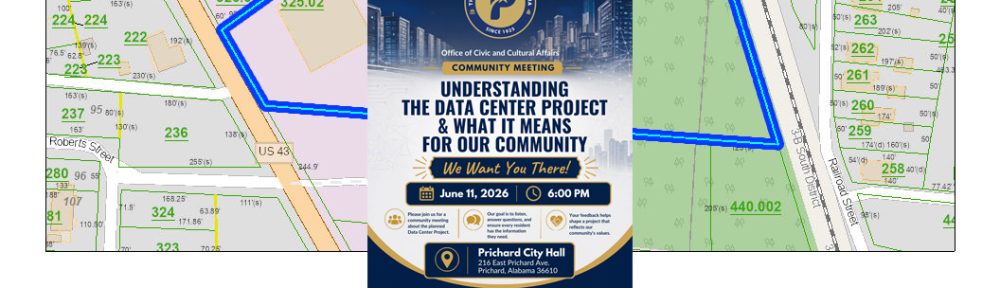
Also before we jump in feet first, please make note of the next City of Prichard Community Meeting about the proposed “small scale” AI data center on the Africatown side of Prichard, set for Thursday, June 11 at 6pm at Prichard City Hall, 216 E Prichard Ave, Mobile, AL 36610. If you care and you are able, you will be there:

The sections ahead are:
- A Little On the Resistance to Artificial Intelligence Data Centers
- On Prichard, Africatown, and MEJAC
- The April 7, 2026 Prichard Community Meeting & Its Aftermath
- Zoning Considerations of the Proposed Facility Location
- Does Edged Target Black Neighborhoods? Does Edged Target Low-Income Communities?
- What are Edged’s “Waterless Cooling” Systems like Up Close? Are they as Noiseless as Advertised?
- Africatown has Air Pollution Challenges. Would an Edged AI Data Center Pose any Air Pollution Concerns?
- What about Energy Costs? Would our Electric Grid be Able to Meet the Demands of Edged’s Clients?
- A Second Community Meeting – Thursday, June 11 at 6pm. What Corrupt Practices are they Employing? Isn’t this a Done Deal?
- Prichard has Needs. What Community Benefits Guarantees are Edged Willing to Make? How Will they be Codified?
- We’re Still Against The Prichard Data Center! Say No! Don’t be Thoughtful; Be Popular! Etc! – A Closing Thought about MEJAC’s Hard Earned Skepticism and an Invitation to Engage with us
A Little On the Resistance to Artificial Intelligence Data Centers
We at the Mobile Environmental Justice Action Coalition (MEJAC) will not be pretending to speak with any appropriate authority on the broader role of Artificial Intelligence (AI) in society. There are many (link)… many (link)… others (link)… who can and do (link)… speak to those concerns (link)… with more depth and accuracy (link)… than MEJAC.
Some say that all AI data centers are fine, because AI will do everything for us eventually, and the only appropriate response to that is “will it pay my bills?” Cause if the proposals those people are backing won’t be paying bills, those people are talking nonsense and should be told as much. Billionaire financiers and their facilitators in political power being able to brute-force their way to corner the market on locating the most polluting data center proposals possible in some of our most vulnerable communities imaginable due to the deep-seated corruption endemic to so much of the American (and Alabamian) political system is contemptible and worth every ounce of resistance possible to muster. This has created a “moment” for resistance to AI data centers, and AI data center proposals are quick to become extremely unpopular for it all.
There are more ways to plug in productively with grassroots organizing efforts, too. The NAACP will be hosting an “Alabama Stop Dirty Data Center Briefing” about the status of data centers in the state on Monday, June 8 at 7pmCT*.
(*originally set for June 1, but the it was rescheduled.)
With that said, it’s no surprise that many are concerned about the proposed Edged data center. For their part, Edged has presented what they’re doing in a level-headed, responsible, and non-inflammatory manner, unlike virtually any other AI data center MEJAC is aware of anywhere.
On Prichard, Africatown, and MEJAC
What MEJAC can speak to with depth and accuracy is its role supporting the interests of the Black residents in the part of Mobile County known to some as the historic Africatown community, while others know it as the individual neighborhoods of Plateau and Magazine Point and Happy Hill and Kelly Hill and Lewis Quarters and Hog Bayou, and many more know it simply as the eastern extent of the City of Prichard and the northern residential extent of City of Mobile. These parts have been treated as “an industrial outskirt” of both cities since they were annexed by municipal leadership in the 1960s, and while the South Alabama region as a whole has suffered for far too long from a lack of long term planning and implementation of what plans have been developed, the Africatown community on both sides of the strangely demarcated municipal divide has been especially burdened. Ultimately, the Prichard side of the divide is still “Plateau” even though it lacks a meaningful neighborhood plan to reflect its residents’ agency in the development of their side of the community in black and white. The Africatown community as a whole is otherwise seamless in terms of family, demographics, shared heritage and traditions, schooling, and just about everything else, including proximity to industry and Timothy Meaher and family’s legacy in the area. What to call the space between the City of Mobile’s historic Plateau and the City of Prichard’s historic Whistler neighborhoods is a question for those who live there.
If any of this abstract geographical description confuses you, a map:
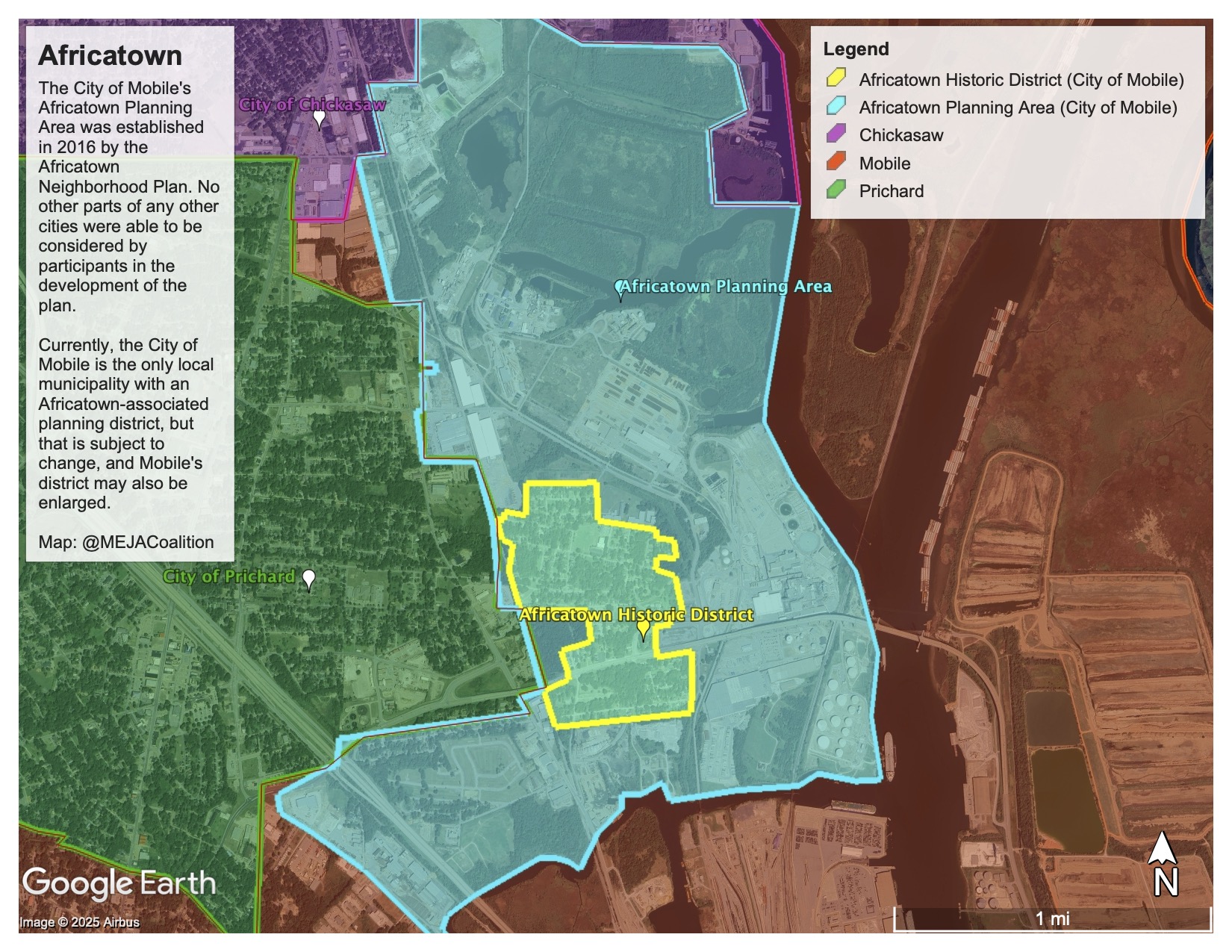
The boot shape of the City of Mobile’s Africatown Planning Area only reflects the subtraction of the Prichard side of Plateau as part of the City of Mobile’s jurisdiction.
For generations, industrial real estate developers and regional planners have treated those who live in these areas with disregard. Since MEJAC was founded in 2013, neighborhood residents, regional stakeholders, and faith leaders that have made up MEJAC’s ranks have repeatedly stood in the gap to demand that developers treat the neighborhood with greater deference and respect for their challenges, including the inappropriate emphasis on the primacy of industrial interests in and around where they have lived, worked, played, and prayed their whole lives – on both sides of the municipal divide tho primarily on the Mobile side. MEJAC’s focus on the Mobile for the last 13 years wasn’t unwarranted; see:
- December 15, 2014 – Proposed Re-Zoning in Historic Africatown Outrages Residents (Residential to Industrial rezoning threats)
- July 13, 2015 –Africatown Boat Safari Highlights Hog Bayou’s Mobile-wide Connections (Public Participation norms being threatened due to selective municipal outreach)
- March 16, 2016 – Protect Historic Mobile from Bulk Petrochemical Tanks (Above ground petrochemical storage tank zoning regulations being watered down)
- May 18, 2018 – Down the Bay & Orange Grove EJ Petitions Delivered to US Army Corps of Engineers (Africatown leads on Public Participation in the Deepening and Widening of the Mobile Ship Channel GRR/SEIS permit process)
- May 27, 2021 – There are Many Reasons Why Africatown Advocates Oppose Tolling on I-10 (Concerning the Mobile River Bridge Project’s impact on Africatown)
- December 24, 2021 – 1490 Telegraph Road Rezoning UPDATE and Future Meeting Info (More Residential to Industrial rezoning threats prompt unusual arrangements)
- March 24, 2022 – Will Africatown be a Safe Zone in Future Decades? De-Coding the UDC, still – Concerns about Mobile’s Zoning Code Rewrite Linger (The development of the Africatown Safety Zone and improvements to the Africatown Overlay District in the City of Mobile Zoning Code)
- March 11, 2023 – Africatown Studios and Substantial Justice: The Good, The Bad, and the Ugly (An open-minded critique of the roll out of the Africatown Studios proposal that proved, sadly, prescient)
- December 30, 2023 – Key Concerns about the Port of Mobile’s Africatown Railyard Expansion Project (Africatown groups enhancing Public Participation and historic district research via intervention in the Port of Mobile’s rail project in Africatown)
- February 2, 2024 – Africatown Asphalt Plan Air Pollution Permit Hearing (Africatown forcing the state to issue a proper air permit after 25 years of a facility lacking one)
- September 25, 2025 – A Hog Bayou Fit for Africatown’s Future (A look at how the Africatown Connections Blueway advocacy efforts are resulting in substantive restoration of public access to and knowledge of the threats to waterways around Africatown and have been connected to Prichard the whole time)
So while much has been written, filmed, and otherwise witnessed about Africatown’s environmental justice struggle, the last thing MEJAC wants is to contribute to the Africatown community’s burden.
Our approach regarding this Edged data center proposal has been careful and with a healthy dose of earned skepticism, which has led to many, seemingly, pleasant surprises. Undoubtedly there are lingering concerns, and we will address those in this blog, but this Edged data center development proposal represents challenges AND opportunities that need careful scrutiny and consideration. If we are to do things differently in Mobile for all the reasons we know we should, then we need to lean in when opportunities like those arise, ask the right questions, and fight for decent infrastructural and economic development that has meaningful and accountable community benefits. Not every proposal will be above board, but by the same token, not every one will be dastardly and derogatory, either.
The April 7, 2026 Prichard Community Meeting & Its Aftermath
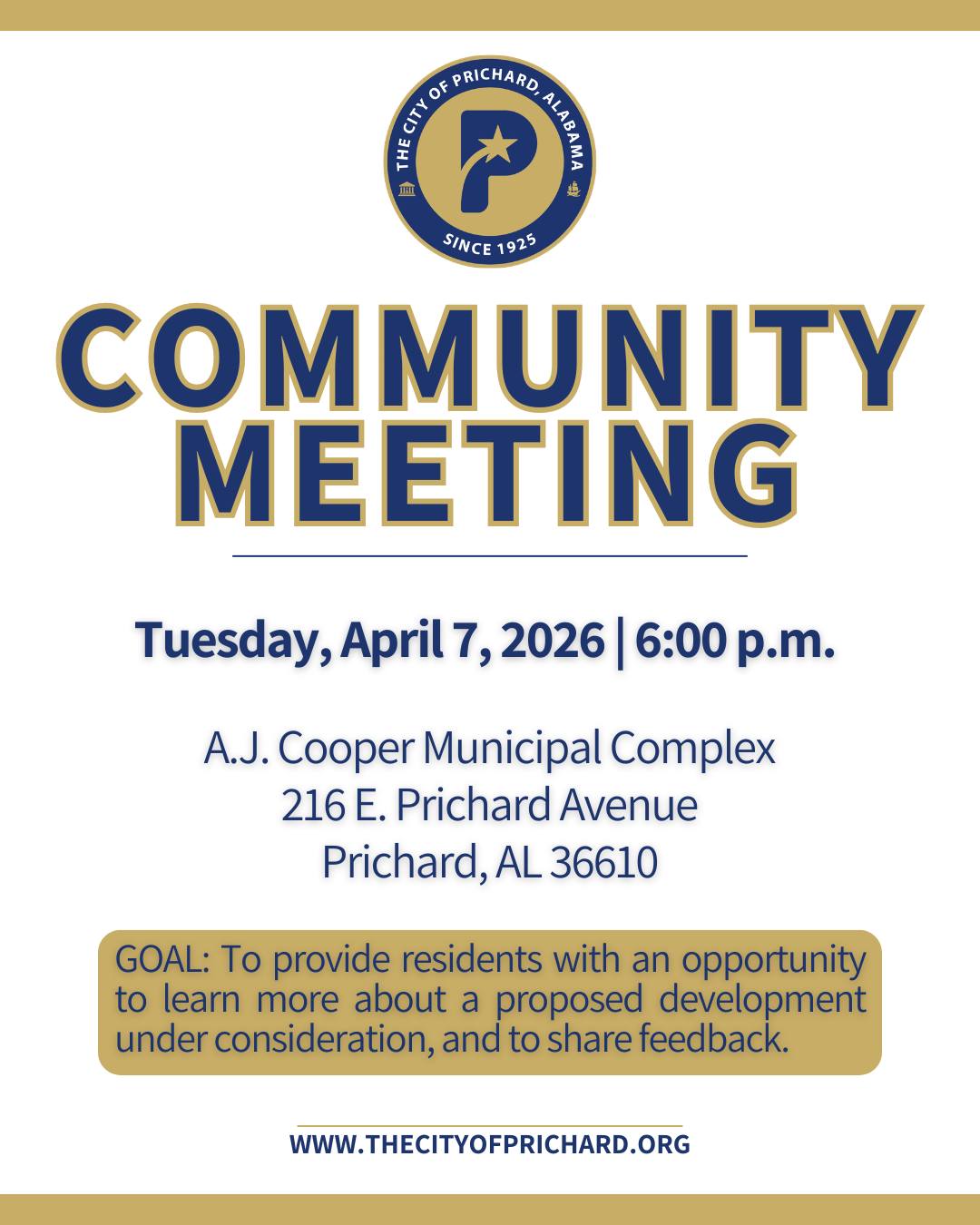
A flyer for the April 7, 2026 Community Meeting hosted by the City of Prichard at Prichard City Hall.
On April 7, 2026, the City of Prichard hosted a Community Meeting with Edged, which was simultaneously broadcast on Facebook Live. The meeting was first promoted by Prichard Mayor Carletta Davis during the March 24 Prichard City Council meeting. A flyer was then distributed in the Mayor’s newsletter and on the City’s Facebook page on April 6.
Unfortunately, although it was up for 30 days, as many a social media manager has learned the hard way, Facebook Live videos get deleted after 30 days, and the video of the Community Meeting presentation and the Q&A was lost. However, the City of Prichard put out the following statement the day after meeting:
On Tuesday, April 7, 2026, the City of Prichard hosted a Community Meeting to provide residents with information and an opportunity for feedback regarding a potential new development by Edged Energy.
During the meeting, representatives from Edged Energy introduced their company and outlined plans for a proposed data center project. They explained that data centers serve as the infrastructure behind everyday digital activity, supporting services such as email, messaging, streaming, and data storage. The presentation aimed to help residents better understand the role of this technology and how it could be responsibly integrated into the Prichard community.
The proposed project represents an estimated $93 million investment in the City of Prichard and is expected to create approximately 20 high-paying jobs, with salaries exceeding $70,000 per year. Representatives noted that, in addition to direct employment, the project could contribute to broader economic activity and long-term growth within the city.
Edged Energy emphasized its commitment to responsible development and community partnership. Company representatives shared that their approach focuses on long-term investment in the communities where they operate, including support for workforce development, education initiatives, and local engagement efforts.
The presentation also addressed key community concerns related to noise, traffic, and environmental impact. Edged Energy stated that its facilities are designed to operate quietly, comparable to the sound level of a normal conversation, and are typically located in industrial areas to minimize disruption to nearby neighborhoods. Representatives noted that traffic associated with the facility would be limited and manageable.
Environmental considerations, particularly water usage, were also discussed. Edged Energy highlighted its use of advanced technology designed to reduce strain on local resources and improve overall efficiency. The company acknowledged the importance of transparency and ongoing dialogue regarding environmental impact. More insight on the ThermalWorks water cooling process can be found here: https://edged.us/news/edged-partner-thermalworks-launches-advanced-waterless-cooling-system-worldwide
The City of Prichard remains committed to ensuring that all potential developments are carefully evaluated with a focus on community impact, economic opportunity, and long-term sustainability.
How does all that sound to you?
Zoning Considerations of the Proposed Facility Location
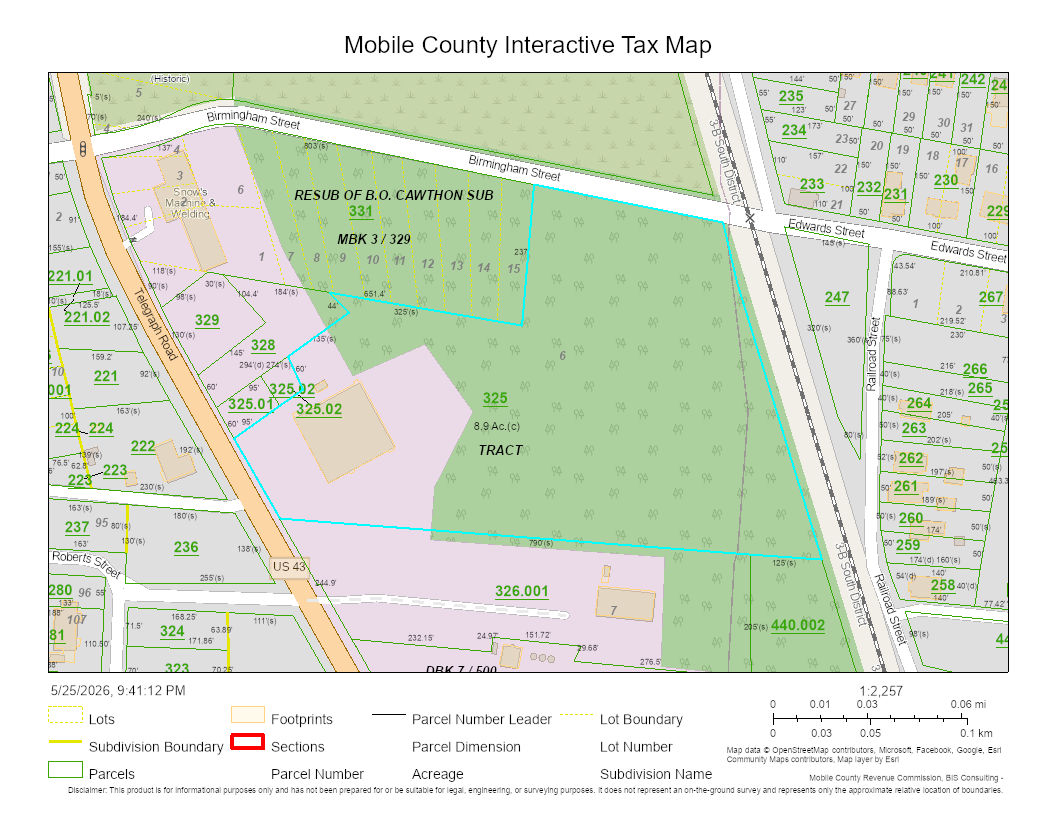
The address of the proposed data center would be 214 Telegraph Road, Prichard, AL 36610. The parcel in question sits mostly within the City of Prichard but about 11% of the total property is within the City of Mobile along the Norfolk Southern railroad line. According to community folklore that railroad is responsible for the name “Plateau” being used for the land on either side of the railroad through the area. The dual municipal jurisdiction of this one parcel underscores the interconnectedness of Plateau described earlier, but he dual jurisdictions also potentially introduces dueling permitting requirements.
 As described before, MEJAC led a multiyear effort to involve Africatown residents and stakeholders in the City of Mobile’s Zoning Code Re-Write process called the “Unified Development Code”. Through the efforts of many, the Africatown Overlay District was strengthened and ultimately included many targeted industrial land use restrictions to ease residential angst over the threats posed by industrial encroachment. These enhanced restrictions became codified as the Africatown Safety Zone (see page 8 for a Safety Zone map and list of restrictions).
While the proposed Edged data center property would fall within the extent of the Africatown Safety Zone, “Data Processing, Hosting and Related Services (including Data Centers)” is not a restricted land use within the Africatown Safety Zone. However, the Mobile side of the property is zoned R-1 Single-Family Residential, the most restrictive zoning designation in the City of Mobile, and “Data Processing, Hosting and Related Services (including Data Centers)” is simply not a permitted use in those zones (see page 61 for the relevant Use Table reference).
All of those City of Mobile permitting considerations could very easily be rendered entirely moot if Edged simply chooses to keep the entire footprint of its proposed data center within the City of Prichard, because Prichard doesn’t have any comparable planning and zoning guidance protecting the residential interests on their side of Africatown. MEJAC certainly hopes that a neighborhood plan for those residents that is harmonious with their quality of life goals can be developed for the Africatown side of Prichard in the near future.
All that said, on April 13, 2026, MEJAC hosted its monthly virtual Community Meeting (subscribe to our Mobile Environmental Justice Newsletter here to get the login credentials for future meetings), and a Prichard resident who attended the meeting provided a report for those gathered who didn’t or couldn’t attend or watch the Facebook Live video of the April 7 Prichard Community Meeting, obviously, had many questions, especially about what was and wasn’t believable. The MEJAC community’s healthy, earned skepticism driving concerns.
What was clear from the hour-and-half-long MEJAC meeting discussion among seasoned community advocates was that we needed more information and to hear it from the source. MEJAC reached out to Prichard Mayor Carletta Davis with the concerns its meeting attendees raised, which in turn prompted the Mayor to invite MEJAC President Ramsey Sprague to join her and her team members for an in-person tour of an Edged data center campus in Atlanta, Georgia at 1800 Thomas Street on May 1, 2026.
Does Edged Target Black Neighborhoods?
Does Edged Target Low-Income Communities?
The nearest similarly-engineered Edged facility to Prichard is their “hyper scale” one at the CSX railroad’s former “Tilford Yard” freight yard on Atlanta’s Westside, off the Marietta Blvd corridor headed towards the Chattahoochee River from downtown.
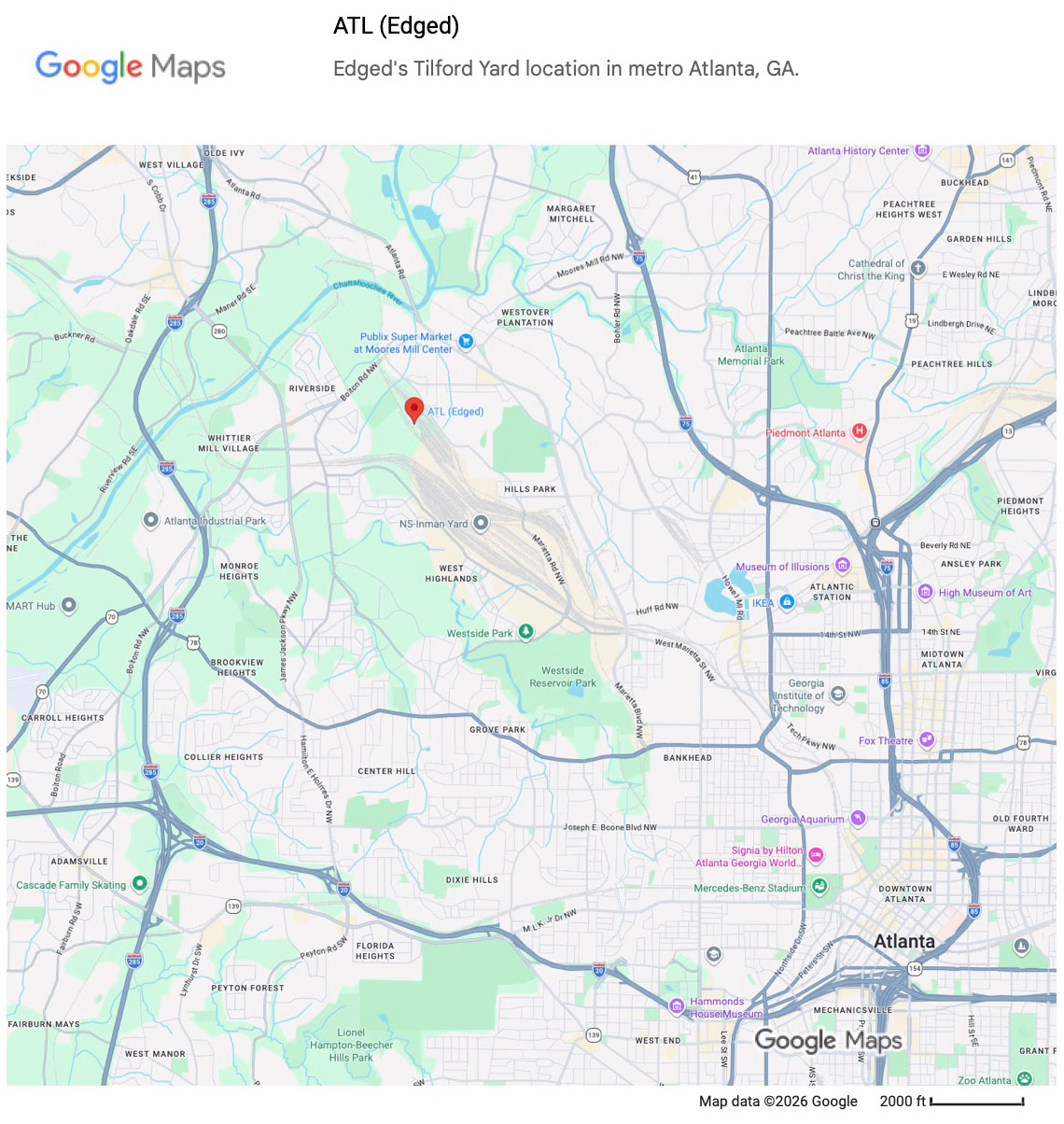 This facility is /extremely/ close to its residential neighbors – shockingly so! The largest of its three buildings is less than 250 feet from the nearest home:
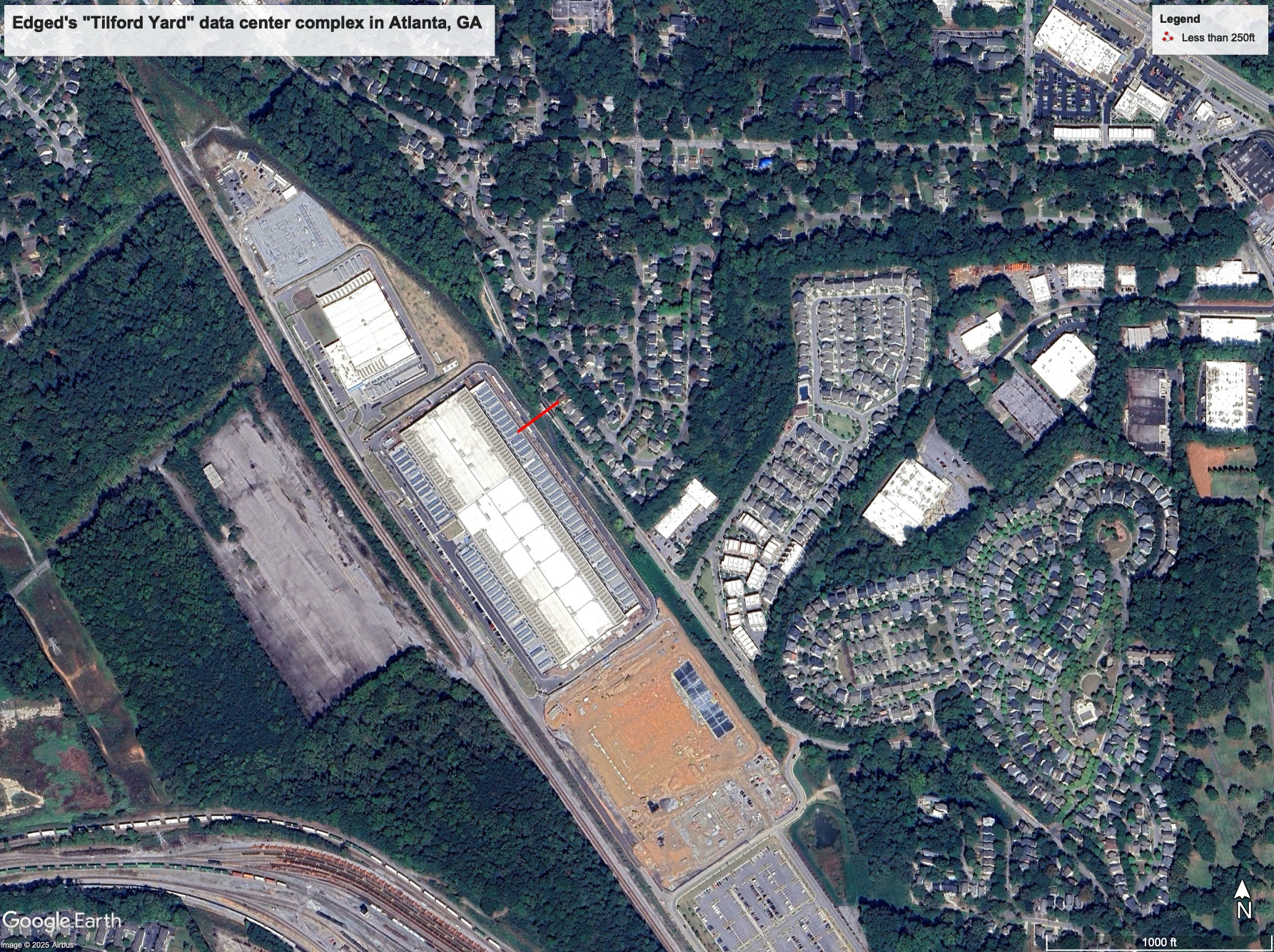
The red line measures less than 250 feet! That’s extremely close! The third building, seen as a barren pad in this image is nearing completion currently.
Obviously, their relationship to their neighbors naturally came up. To those questions, Edged explained that the only complaint they have ever received was that one of their security lights was shining into a nearby home. Edged subsequently shielded the light so it stayed shining only on their property, and they said they haven’t had any other complaints since. There’s no record of any complaints about the operations of this facility anywhere that MEJAC has been able to find, either, which itself is impressive for a “hyper scale” AI data center anywhere let alone one as close to occupied homes as their Atlanta facility is.
But WHO lives there? The Tilford Yard facility sits in Census Tract 88.02, and according to the latest US Census data (2024), its demographic break down includes:
- Median Age: 34.8
- Race & Ethnicity: 67% White (not Hispanic), 17% Black or African American (not Hispanic), 11% two or more races, 4% Hispanic or Latino (any race), 2% Asian (non-Hispanic)
- Median Household Income: $166,310
- Median Value of Owner-Occupied Homes: $623,400
But is this ONE facility in Atlanta truly representative of the demographic makeup of the Census Tracts of each of Edges’ 7 facilities listed on their website? MEJAC aggregated that demographic data and those numbers provide an interesting portrait of Edged’s neighbors across the US that largely mirror the Atlanta facility:
- Median Age: 35.4
- Race & Ethnicity: 65% White (not Hispanic), Hispanic or Latino (any race) 18.3%, Asian (not-Hispanic), Black or African American (not Hispanic) 2.9%
- Median Household Income: $131,465
- Median Value of Owner-Occupied Homes: $476,821
So, in terms of their overall pattern, Edged certainly does not appear to have have a pattern of targeting Black communities or any other communities of color at all. They also do not have a discernible pattern of targeting low-income communities at all.
What are Edged’s “Waterless Cooling” Systems like Up Close?
Are they as Noiseless as Advertised?
Those on the tour took several hours to look around at their security systems, their “waterless cooling” systems, their on-site compressors for moving the coolant, their emergency backup generators, and we got to feel the warm (but not shockingly hot) air coming off their server racks as they were working at full blast.
Their waterless cooling system essentially uses “anti-freeze” instead of a regular HVAC system to manage the heat generated by the server racks they host. They aren’t moving municipal water to cool the air like how hospitals, large schools, and other large facilities do. This doesn’t mean that their facility would use zero water. It means that their overall water usage could reasonably be projected to be similar to that of any building occupied by a dozen or so people at a time.
Also unlike typical large buildings, they aren’t reliant on a small number of extremely large and noisy compressor pumps to move the liquid through their heat exchange/HVAC system. Instead, the Tilford Yard facility has bank of many dozens of smaller electric compressor pumps, which is why this facility was so much less noisy than other “hyper scale” data centers. Those on the tour were able to maintain conversational speaking tones standing next to these massive banks of smaller compressors. They were shockingly quiet given their number and the job they were performing. These are custom manufactured by Edged’s sister company ThermalWorks:
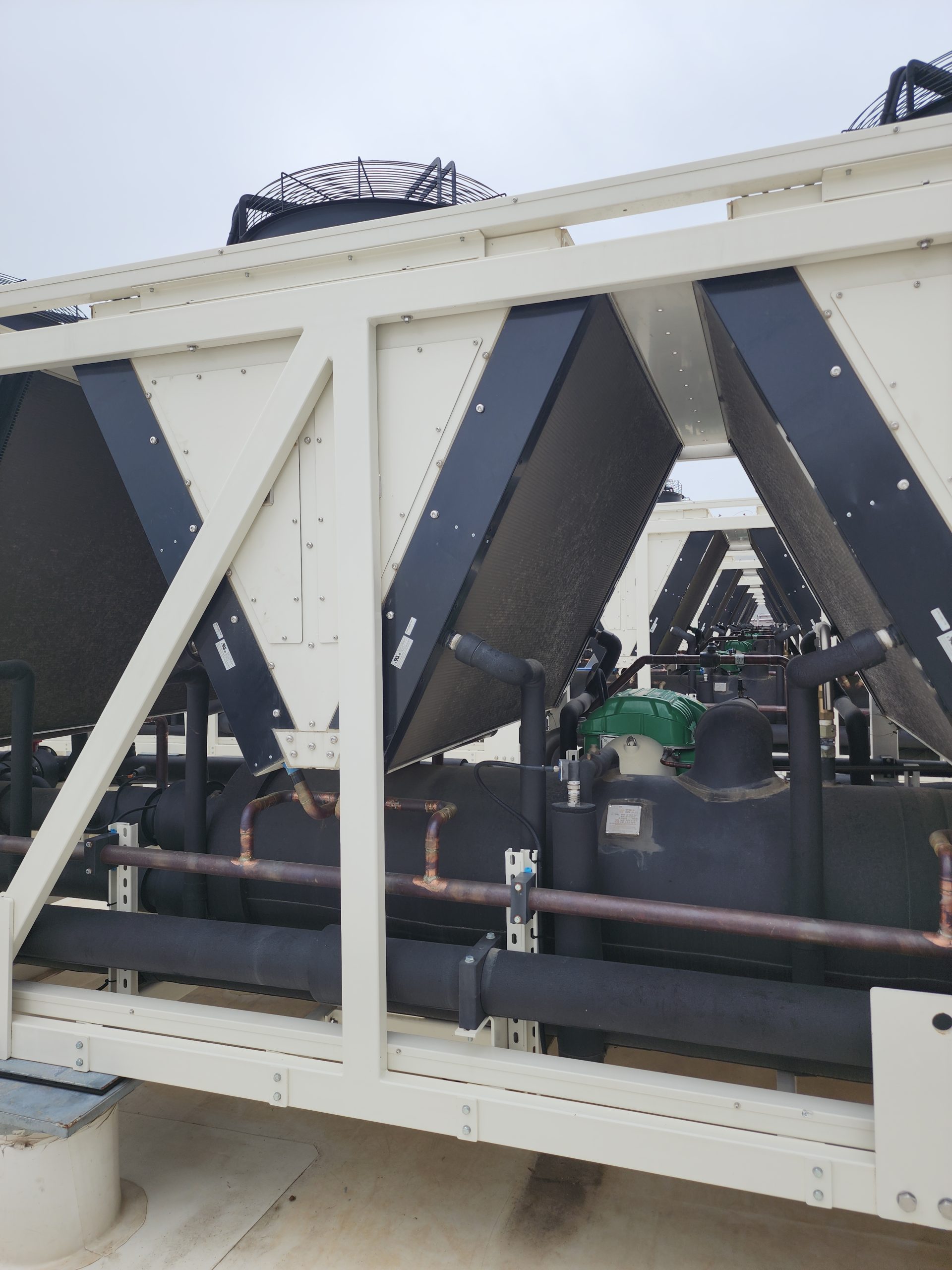
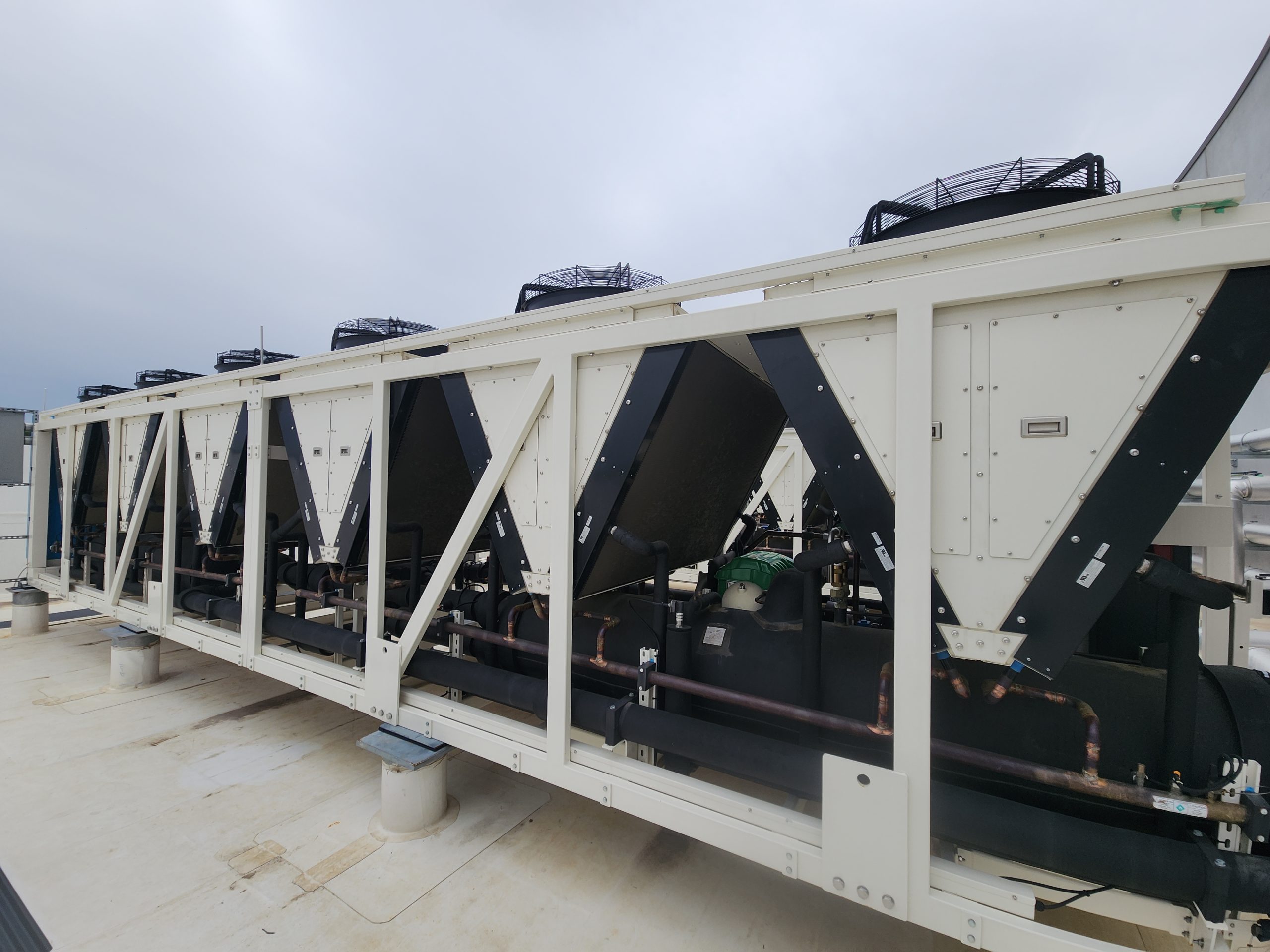
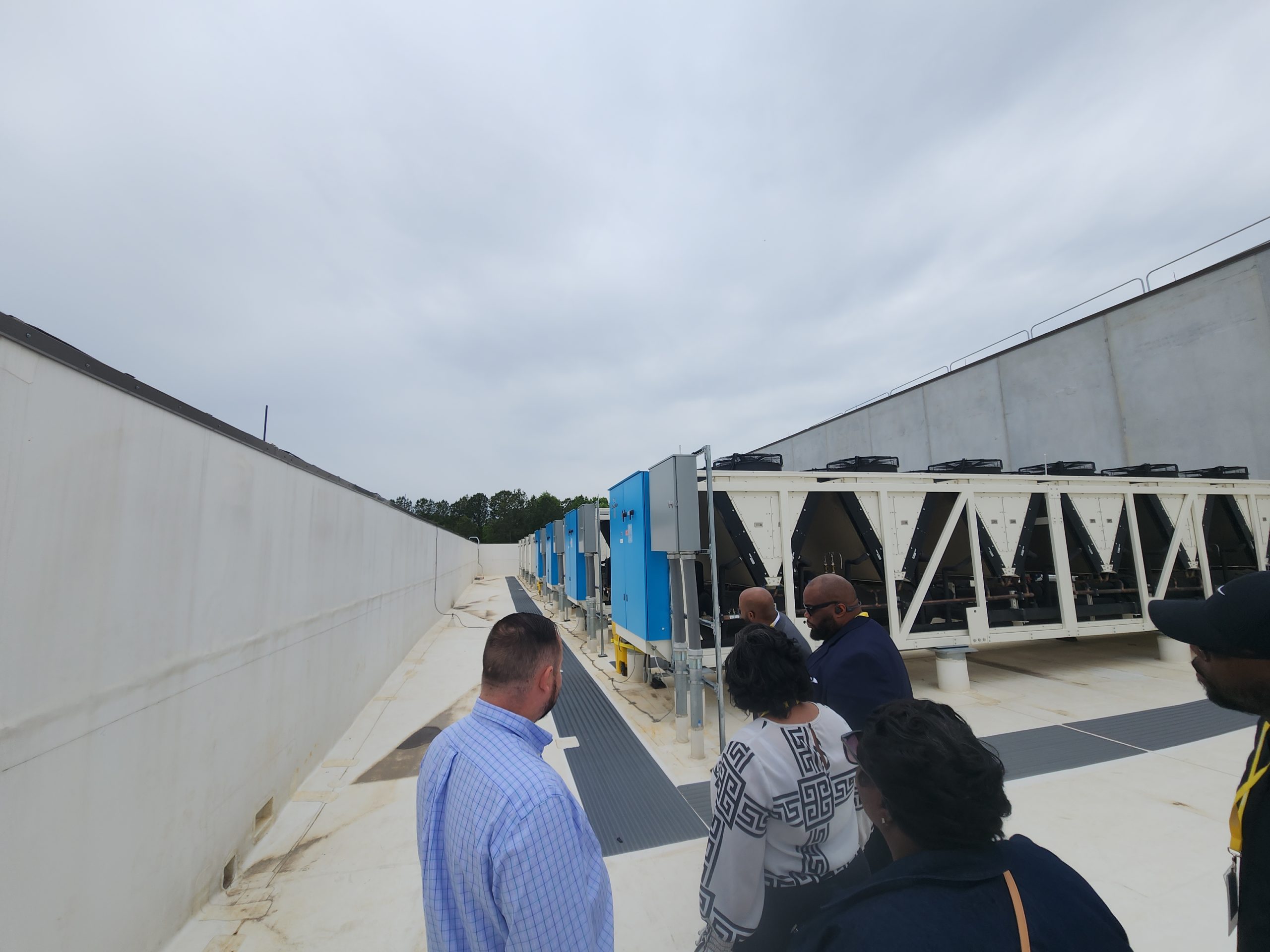 Overall, quiet, indeed.
Now, inside the data center floor rooms where server racks are stored, it was pretty windy, but normal conversations were still able to be had. In the rooms where heat was pulled from the racks into the heat exchange system, same story except warm. The noisiest parts of the Edged facility simply do not carry to the outside. As the City of Prichard said in their recap of the April 7 Community Meeting, Edged claims that their normal facility operations are “as quiet as a normal conversation” are eerily accurate, actually!
The antifreeze-like mix that moves through the car-like radiator heat exchange pumps is also like that in any car: glycol and water. This raised a different set of questions that came up during the May 11, 2026 MEJAC virtual Community Meeting that Mayor Davis attended to recap the May 1 Atlanta facility tour.
Like anyone who has owned a car for the long-haul knows, operators are eventually encouraged to flush their antifreeze from their radiators and to replace it. What happens if Edged has to replace the glycol & water mixture in their system? Would it go down the drain to the Carlos Morris Wastewater Treatment Plant, which is one of two wastewater treatment facilities in Africatown, located on the Prichard side at 54 Grover Avenue? What if there was an emergency release of the liquid for some reason? What happens then? Mayor Davis was unsure about whether or not that was even an eventuality that Edged had considered or not, so she posed the question to Edged, and they provided the following response:
“Water Usage: Our closed-loop system does not rely on municipal water or wastewater systems for operations. It uses a glycol/water mixture that does not require ongoing water consumption. The facility will only connect to the local water system for basic domestic uses (e.g., toilets, sinks). Our facility will save 23 million gallons of water annually – equal to 200 Prichard Households
Glycol / water mix: There is no defined end-of-life for the glycol / water mixture, so there are no routine replacement or potentially operations [sic] expected. If we ever do have to do a full replacement (highly unlikely), the fluid would be removed by a licensed pump truck and sent offsite for proper treatment and disposal. It is prohibited to by law to discharge mixture to stormwater or municipal wastewater systems and Edged would act in accordance with the local laws / regulations”
[their emphasis]
Africatown has Air Pollution Challenges.
Would an Edged AI Data Center Pose any Air Pollution Concerns?
The answer is yes, but mostly as an intellectual exercise. Most of the time, the proposed Edged data center in Prichard would simply draw power from the Alabama Power Company (APC) grid. Locally, APC purchases power from the Hog Bayou Energy Center, a methane-burning power plant in Africatown’s Hog Bayou area. That power plant has localized impacts regulated through their Clean Air Act Title V Major Source Operating Permit. Like with all facilities in and around Africatown, MEJAC and its Africatown community based organization coalition groups have a history of intervention and review the air pollution permitting procedures conducted by the Alabama Department of Environmental Management (ADEM) for this facility. So, the particular challenges of the APC electric grid power generation here in Africatown and elsewhere (like Plant Barry) are no stranger to us, and we continue to push for better air monitoring through the region and ADEM largely continues to ignore us, though we are collaborating with ADEM to re-locate the National Ambient Air Quality Standards (NAAQS) corresponding air monitor from Chickasaw to Africatown in 2026.
So, as far as the status quo goes, this facility will do nothing to address the infrastructural limitations Alabama Power Company customers face in Mobile County in terms of electric generation air pollution, but Alabama Power customers also know well, sometimes the Alabama Power’s grid fails and the power goes out. And sometimes it goes out for a long time, like if a big storm blows through the area.
As part of their business model, Edged must provide constant service to their clients and that means if the electricity provided by Alabama Power Company’s grid fails, then their backup generators must do the job. At their Tilford Yard facility, the company relies on industry-standard Volvo Penta diesel generators. At their proposed 6mw Prichard facility, they could require as many as 15-25 of these units to meet the demands on the facility, and those units would require on-site fuel storage, as well.
Even if the power never went out, Edged would still need to test their backup generators every month, which would probably produce enough industrial air emissions (mostly NOx and PM) to warrant a Synthetic Minor Source Air Pollution Permit under the Clean Air Act. However, assuming the use of Volvo Penta diesel generators with their modern diesel pollution control devices built-in, overall emissions at the proposed Edged facility in Prichard would be comparable to those emitted by neighborhood BBQs over the course of a year (assuming one BBQ session would generate 10-30 g of PM and there are 150-300 grills fired up at homes in the area at different points in any given year). That’s not zero, but that would by any measure pale in comparison to most any of the other facilities issued air pollution permits through the Alabama Department of Environmental Management in the Africatown area, which are measuring toxic air pollution amounts in the dozens or hundreds of tons per year:
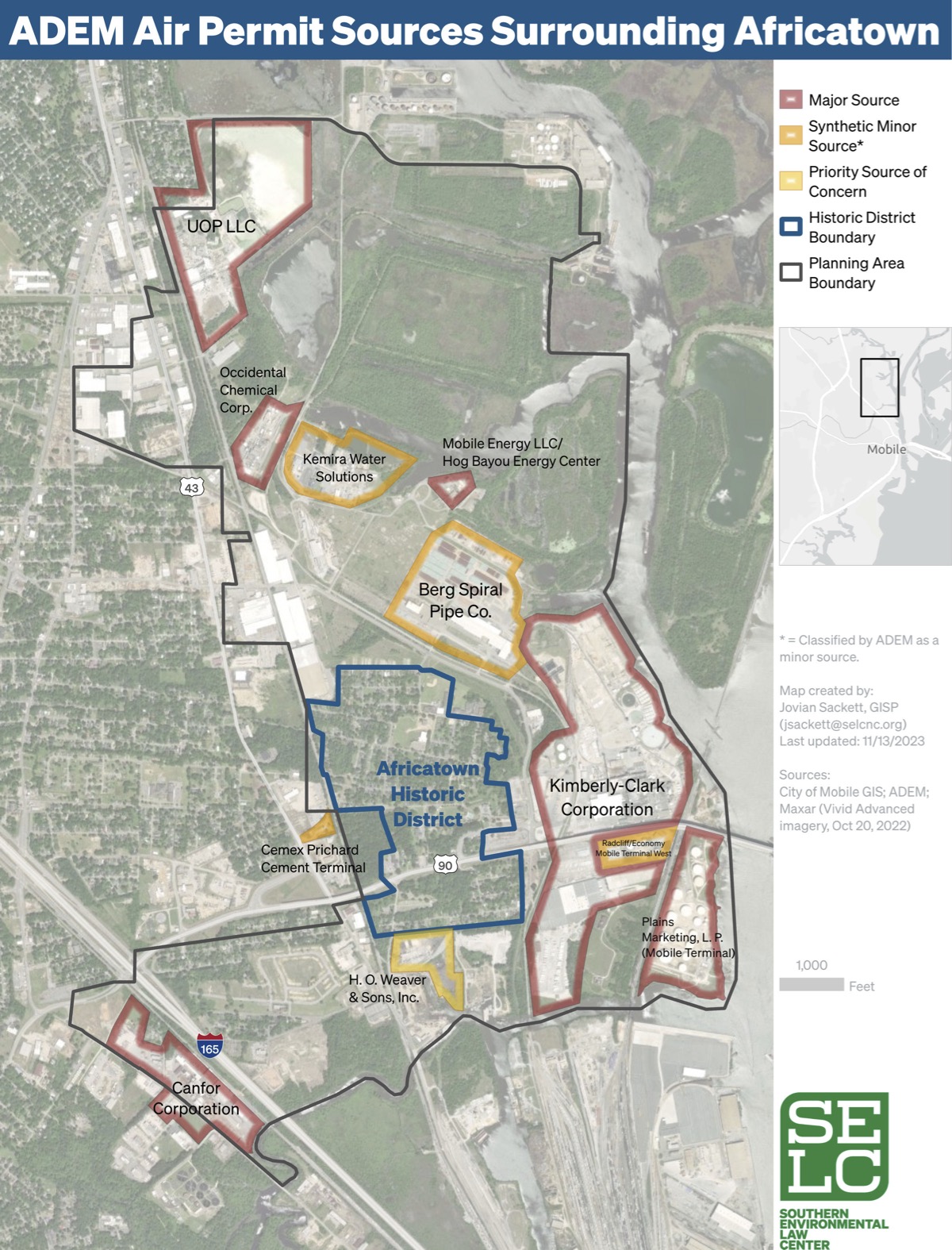
• Kemira Water Solutions is now Sterling Specialty Chemicals • Berg Spiral Pipe Co. is now Borusan Berg Pipe • HO Weaver & Sons, Inc is now APAC Alabama Inc.
MEJAC takes air pollution in Africatown seriously, because modern science confirms the seriousness of its impacts. Numerous sources of toxic air pollution aren’t even properly accounted in state air pollution permits like transportation corridors like highways and railroads:
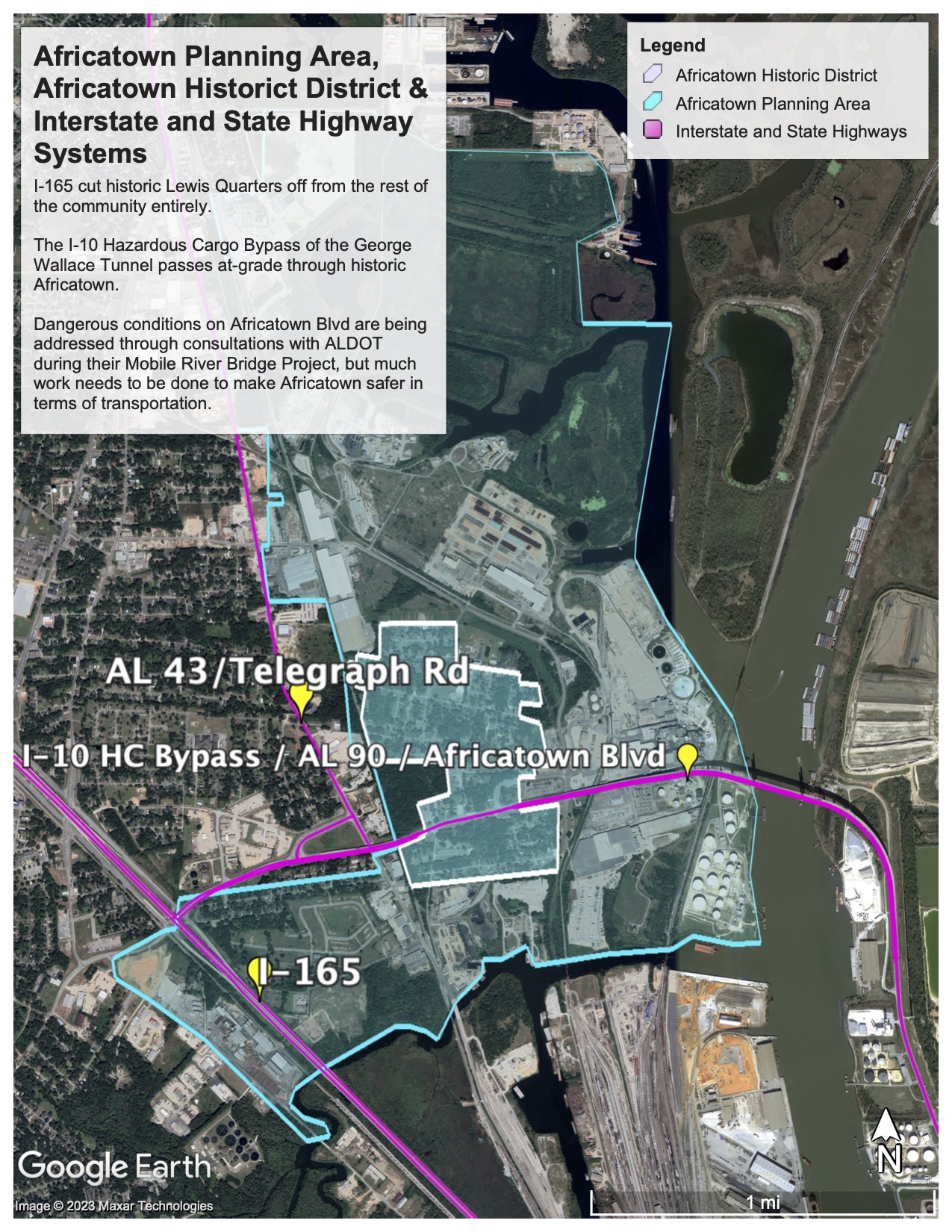
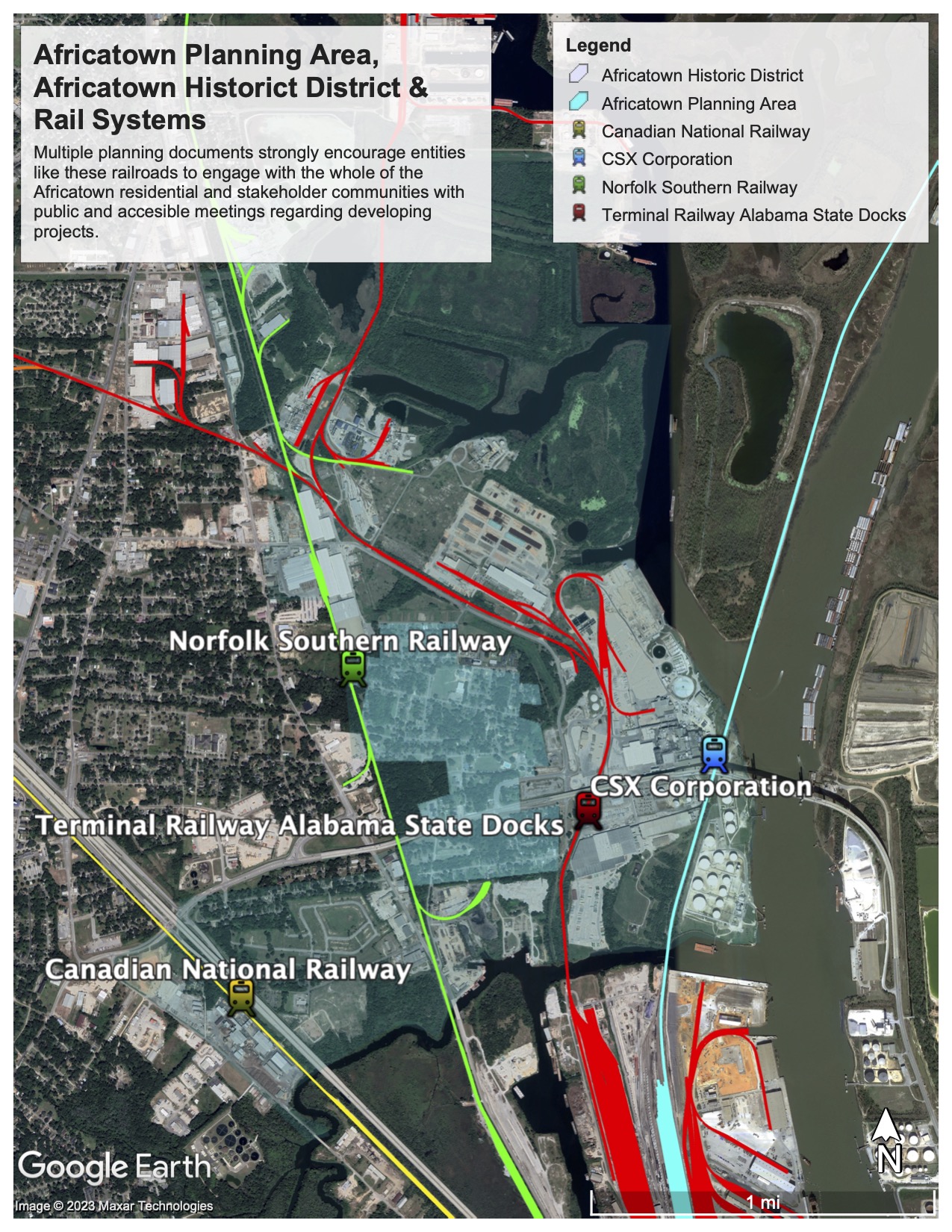 With such a concentration of air pollution sources accounted and unaccountable, we aren’t thrilled to have any contribution to the air mix in Africatown. But the proposed Edged AI data center’s contribution would be minimal in the grand scheme of developments of comparable size and investment. All in all, their massive Atlanta facility was a testament to what intentionally thoughtful engineering can do to both meet data access demands in creative ways and be more ecologically-friendly.
What about Energy Costs?
Would our Electric Grid be Able to Meet the Demands of Edged’s Clients?
These last several months of economic instability and inflation saw political pressure push the Alabama legislature to change how electric rates are regulated in the state under the Public Service Commission. While some good reform legislation was not passed, and some bad reforms were passed, the attention was unprecedented, and the same tenderness about the rising costs of everything dang thing has resulted in the Alabama legislature passing a law that temporarily freezes the (already high) electricity rates that consumers pay to Alabama Power Company. There haven’t been any formal rate hearings where Alabama Power Company has to defend their shockingly high rate of return for their Wall (and Wannabe) Street investors since 1982! And there won’t be another one before 2029, according to the legislation passed in this 2026 Alabama legislative session. So, electric rates will go unchanged until then with or without the proposed Edged data center in Prichard, or anything else for that matter.
Also passed was a law that requires “the Alabama Public Service Commission to consider the public interest when approving data center contracts”, though it only applies to those requiring 150mw or more of electricity. Alabama Power has an explainer of sorts about these changes on their website. However, the proposed “small scale” Edged data center in Prichard would only require 6mw, and there’s good reason to believe that the existing local capacity would be relatively unimpaired in terms of infrastructure necessary to delivery that load from the grid to the proposed data center. For instance, high-power electric transmission lines from Africatown’s Hog Bayou energy center already exist to carry power to multiple large consumers throughout the area.
Considering all that, Prichard Mayor Carletta Davis put the question to Edged about their relationship to Alabama Power Company in terms of planning for their proposed 6mw operation in Prichard, and Edged responded:
“Power Commitment: Alabama Power has confirmed this project will not increase local electricity rates. No material grid upgrades or utility-funded infrastructure are required and service to project site will be delivered from existing local infrastructure. We are not constructing a substation and will fund any required distribution line extensions to project site.
Under the draft service agreement, Edged is fully responsible for ensuring its operations do not impact grid reliability or power quality, and we are obligated to resolve any issues at our sole expense”
[their emphasis]
So in this instance, it appears that with or without binding legislation requiring them to do so for “small scale” data centers, Alabama Power Company is mirroring their “hyper scale” rules for the proposed Edged data center.
A Second Community Meeting – Thursday, June 11 at 6pm.
What Corrupt Practices are they Employing? Isn’t this a Done Deal?
After the tour, Edged reiterated their commitment to conduct at least one additional Community Meeting to hear from more residents and stakeholders and generally concerned neighbors. That meeting has been announced to be on Thursday, June 11 at 6pm at Prichard City Hall, 216 E Prichard Ave, Mobile, AL 36610.
Edged also committed in principle to not pursue any environmental or building permits until at least this Community Meeting has happened and they had more demonstrated buy-in from their potential neighbors.
MEJAC has confirmed that they have not sought any permits from any regulatory agencies or governments. If you read the statement from Edged above regarding their service agreement with Alabama Power, you will see that they qualify it as a “draft” service agreement. This commitment to meeting with community members without a legal process already at stake is virtually unheard of with Africatown-area proposals.
During the 2024 Alabama legislative session, the Africatown Studios project went ahead and lobbied for several tens of millions of dollars in Alabama taxpayer subsidies after unceremoniously ending their public consultation process entirely after only one public mass meeting and the threat of a mostly skeptical but open-minded report about their proposed business was published by MEJAC in the fall of 2023. It failed in its bid for direct taxpayer subsidies at least partially because the project failed to abide by basic, common sense public participation norms, especially those for public-private partnerships.
In December 2024, The Africatown Blvd RaceWay truck stop started building on land formerly owned by the Meaher family’s real estate holding company in December 2024 and never held a single publicly advertised community meeting ever despite local land use restrictions against truck stops in the proximate Africatown Safety Zone (not applicable in the truck stop’s Prichard location, unfortunately). Just a mere couple months after the sale of the property in question, Meaher family representatives met on CBS 60 Minutes with descendants of the survivors of the enslaved Africans trafficked by Timothy Meaher and others on the infamous Clotilda slave ship. One of those individuals in those nationally televised talks lives less than a whole block away from the truck stop. Despite those facts, neither the company nor the Meaher family ever even mentioned the transfer of such a large piece of Africatown’s land much less published a press release.
For the last decade, the former HO Weaver & Sons Inc asphalt company (now APAC Alabama Inc) refused to meet with their Chin Street neighbors in Magazine Point for any consultative process despite Consent Orders being issued by ADEM and an air pollution permit Public Hearing process that left no doubt how their neighbors felt about the company’s practices. It wasn’t until a year ago in May 2025 that they starting meeting with residents to discuss concerns. By then, HO Weaver had sold their family business to a subsidiary of the multinational “CRH plc” called APAC Alabama Inc and had already received their thoroughly-criticized air permit from ADEM. Despite the company assuring residents that they are implementing improvements, emissions from that facility are still aggravating and despairing nearby residents.
Just earlier this month in May 2026, APAC Alabama’s next door neighbor Rogers Group Inc only committed to community meetings with their immediate Chin Street neighbors after they had lawyered up and begun re-construction of their aggregate handling equipment earlier this year and had already submitted a “subdivision application” to the City of Mobile Planning Commission, which is currently pending and will see a Public Hearing on Thursday, June 18 at 2pm at the Government Plaza auditorium. MEJAC’s Public Comment about the substance of that application is here. We anticipate substantial changes to the original application, which will hopefully address the numerous inadequacies we found, but the point of all these anecdotes is to contrast these various behaviors with those of Edged.
Unlike the scandalously anti-public participation stance of those behind the Project Marvel “hyper scale” AI data center in Bessemer, Alabama, to the best of anyone’s knowledge Edged has never presented anyone in the Mobile area with a Non-Disclosure Agreement about their proposed “small scale” AI data center for the Africatown side of Prichard. MEJAC inquired to both the City of Prichard and the Edged about this, and both denied the use of any NDAs regarding the proposed project.
Additionally, those who participated in the tour of Edged’s Tilford Yard facility in Atlanta never even met an attorney working for Edged or their parent company Endeavor Inc. It is unlikely that any Edged attorneys will even be present for the June 11 Community Meeting.
Prichard has Needs.
What Community Benefits Guarantees are
Edged Willing to Make? How Will they be Codified?
Paying municipal taxes alone isn’t the only way to support the City of Prichard and its needs. Here are some suggestions that MEJAC has heard mentioned by community members and leadership. Edged could:
- make targeted charitable contributions to strengthen educational attainment in local school as well as augment their STEM/STEAMM curriculum;
- provide for preferential hiring practices above and beyond their post-construction “20 permanent jobs”, including for the other myriad building maintenance services that don’t count towards that “20 permanent jobs” number like plumbing services, electrical services, and janitorial services;
- take voluntary deed restrictions that would prevent their facility from intensifying land use if they were to have to close their “small scale” AI data center, like other Africatown-area warehouses have;
- or any other good idea that the community might have.
MEJAC hopes that after mostly irrelevant (but understandable) environmental concerns are addressed, the June 11 Community Meeting is productive in these regards. All struggling communities deserve the space to dream of how relationships with business interests could be /different/ than they have historically been, especially if they’ve historically been ugly.
We’re Still Against The Prichard Data Center! Say No!
Don’t be Thoughtful; Be Popular! Etc!
– A Closing Thought about MEJAC’s Hard Earned Skepticism and
an Invitation to Engage with Us
As was stated at the top of this blog post, “this blog post is for folks looking to understand the proposal and what it represents more clearly, especially in contrast to other Africatown development proposals and other hyper-scale data centers, which are plaguing communities all across the country at the moment, including in other parts of Alabama. Especially and obviously, tracking whether or not this particularly Black corner of Mobile County was /targeted/ due to its racial makeup is also extremely important.”
Well, surely, MEJAC has been able to raise and address other concerns that you might not even have thought about before reading this. We are able to do this because we work very hard to listen to the community that created MEJAC and to network these community members with similarly situated communities around the US to learn best practices to resist being steamrolled by special interests or being taken advantage of by unscrupulous charity groups (and political charity groups) offering “help” without any actual functional relationship to area residents or the much larger stakeholder community that grew up in and around Africatown’s neighborhoods.
In a time when your average AI data centers are extremely unpopular, nuanced discussion about AI data centers that are not average is hard to find. MEJAC risks being cast in an unpopular light. But MEJAC was not created to be the most popular group on the block. MEJAC was founded September 2013 by Africatown residents in partnership with Africatown stakeholders and regional advocates with the mission to engage and organize with Mobile, Alabama’s most threatened communities in order to defend the inalienable rights to clean air, water, soil, health, and safety; to promote environmental justice; and to take direct action when the government fails to do so, ensuring community self-determination.
MEJAC hasn’t changed all that much (ask everyone still involved with MEJAC who are now 13 years older now than when we started; it’s quite a few of us). But apparently, and disorientingly so, sometimes business practices do change. In those rare cases, hard earned skepticism can be rewarded.
If this blog challenged your way of thinking about this particular “small scale” AI data center proposal or broader development in and around Africatown, please share it.
If you are actively concerned about the data center and have been loud about it and have been gathering attention because you oppose it (and why wouldn’t you be concerned with everything else going on everywhere else), please share this with those you are chatting with about this proposed data center. If honor doesn’t, curiosity alone about how anti-data center allies might react would demand it, right? If there’s anything we really need more of, it’s decent examples of how implementation of new technologies could be done better. They MUST be done better, right? So when they show up better… It’s on us to continue to evolve those discussions, centering front-line/fence-line leadership.
To join the monthly virtual community meetings of the Mobile Environmental Justice Action Coalition, please sign up for our Mobile Environmental Justice Newsletter here. Login credentials are included in the email newsletter.
Thank you for all you do for environmental justice for our communities everywhere, even if is just learning new information and questioning authority (even your own). Environmental justice is still for all.
 ###
###
Thank you for the information!