Key Concerns about the Port of Mobile’s Africatown Railyard Expansion Project

On Thursday, August 24, 2023, the Africatown Heritage Preservation Foundation (AHPF) was CC’d on a Determination Letter from the US Department of Transportation’s Federal Railroad Administration (FRA) for an Alabama State Port Authority Port of Mobile project called the “Chickasaw Railroad Lead Line”. The AHPF, nor any of its key Africatown resident leadership or its community partners had heard anything about this project.

AHPF then called on community partners to familiarize themselves with all the documents the FRA included in the initial email:

FRA’s Determination Letter,
“Chickasaw Railroad Lead Line Phase I Cultural Resources Survey”, the project’s archeology report, and
• the Alabama Historic Commission‘s Section 106 Project Consultation Review Form for Chickasaw Lead Line (with construction scale layouts).

A map of the Africatown railyard expansion project area by Volkert

A map of the Africatown railyard expansion project area by Volkert

Because despite what the project name would imply, the “Chickasaw Railroad Lead Line” project is contained entirely within the City of Mobile’s Africatown Planning Area and comes within 160 feet of occupied residences within the Africatown Historic District, as can be seen in the above figure contained within the FRA’s Determination Letter supporting documents, MEJAC has decided to refer to the project by what it is – a Port of Mobile railyard expansion project within Africatown, the Africatown Railyard Expansion Project.

Based on the invitation for public interveners by the FRA in its Determination Letter, the AHPF took the opportunity to intervene as the first consulting party on behalf of the National Park Service’s Africatown Historic District, which is protected by the National Historic Preservation Act and its Section 106, requiring, among other things, that projects with impacts on national historic districts to consult with parties representing the interests of those districts to ensure that potential impacts are appropriately quantified and mitigated, if necessary.

The AHPF also shared the information and documentation they received with MEJAC and many other community partners. In response, MEJAC, residents, and partner groups produced the following “Key Concerns about the Port of Mobile’s Africatown Railyard Expansion Project” brief to provide as much context to partners as well as the project management team at ASPA, Volkert (the project’s engineering consultants), and US FRA, through which the federal grant dollars paying for the project are administered.

A preliminary meeting was held with AHPF, ASPA, Volkert, and US FRA on Thursday, November 2, 2023 at which all parties agreed to further community engagement. Some questions contained within the following brief were answered during that meeting but most questions are outstanding, as are critical questions about how the project will impact both the Africatown Historic District, its residential integrity, and its residents.

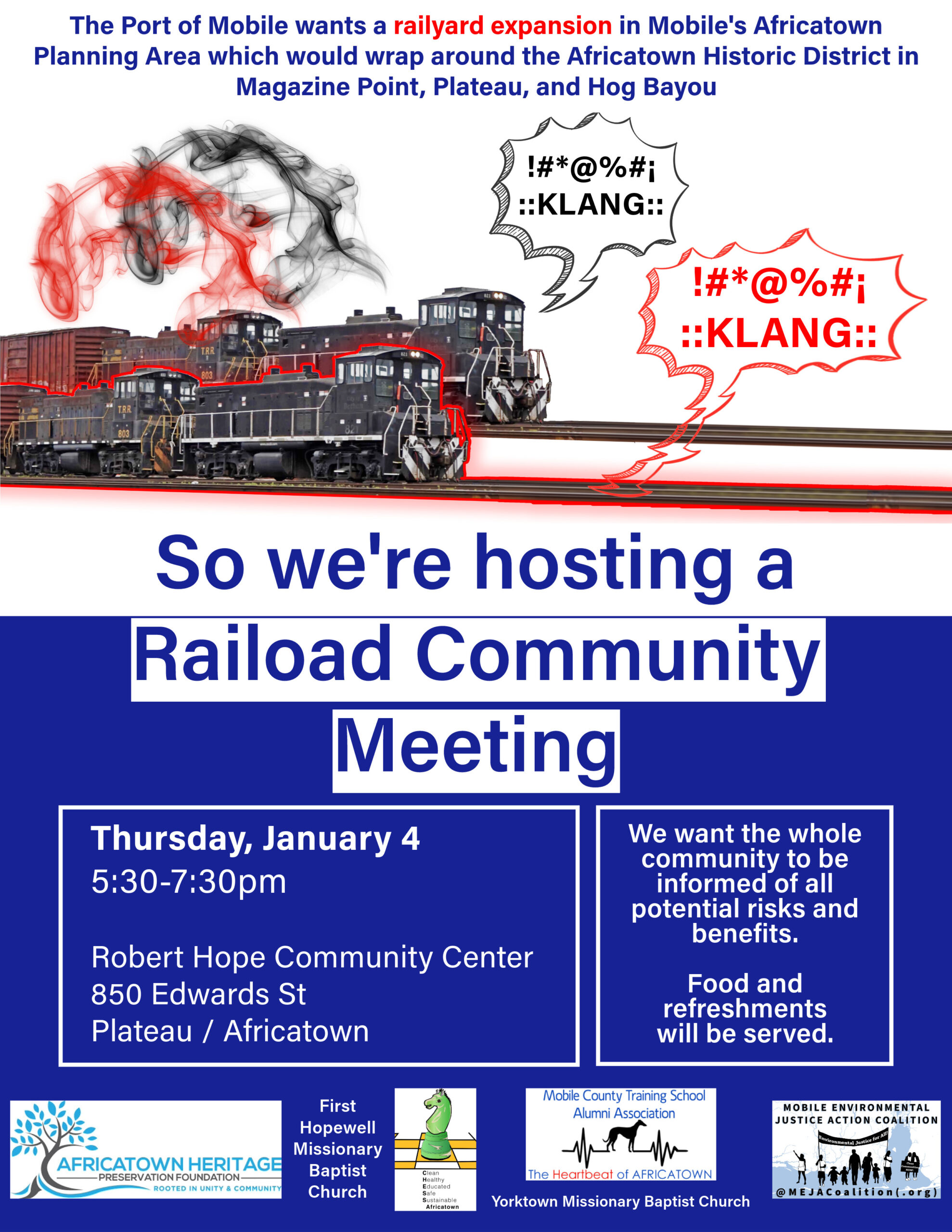
Flyer for a Railroad Community Meeting in Africatown sponsored by the Africatown Heritage Preservation Foundation, First Hopewell Missionary Baptist Church, Yorktown Missionary Baptist Church, the Mobile County Training School Alumni Association, the Africatown~CHESS group, and MEJAC.

Flyer for a Railroad Community Meeting in Africatown

The AHPF, the Mobile County Training School Alumni Association, First Hopewell Missionary Baptist Church, Yorktown Missionary Baptist Church, the Africatown~CHESS group, and MEJAC all agreed to host a Railroad Community Meeting on Thursday, January 4 at the Robert Hope Community Center at 850 Edwards Street in Plateau Africatown from 5:30-7:30p, the flyer for which you can see to the right.

Additional community meetings hosted by ASPA and US FRA will happen soon, as well, though dates haven’t been finalized just yet.

In the interest of sharing as much information ahead of the meeting as possible, MEJAC is publishing the entire “Key Concerns about the Port of Mobile’s Africatown Railyard Expansion Project” brief here without dramatic amendment since its original assembly.

To its credit, the Alabama State Port Authority has been forthcoming with all requested information since the FRA’s August letter was shared, which has been very helpful for advocates and residents. Reflecting the additional information and context, an ADDENDUM to this “Key Concerns about the Port of Mobile’s Africatown Railyard Expansion Project” brief is forthcoming.


Key Concerns about the Port of Mobile’s Africatown Railyard Expansion Project

Table of Contents:

  1. Critical Outstanding Questions about ASPA’s Africatown Railyard Expansion Project
  2. Africatown Background – Africatown Organizes for Much Better Environmental Justice Community Engagement from Federal, State, and Local Authorities
    1. The Africatown Historic District (est. December 4, 2012)
    2. The Africatown Neighborhood Plan (adopted January 2016 by the City of Mobile)
    3. Africatown Public Comment to ASPA’s Mobile Harbor GRR Ship Channel Enlargement Project (January 2016-June 2019)
    4. The Africatown Connections Blueway Place of Baptisms Point Of Interest (est. by Spring 2018)
    5. The Africatown and Africatown Safety Zone Overlays (est. July 2022)
    6. AHPF EPA EJ Collaborative Problem Solving Grant Application (January 2023)
  3. Assessing Where the Goals of Federal Environmental Justice (EJ) Programs and the Justice40 Initiative (Justice40) Fit Into the Project
    1. EJ & Justice40 Background
    2. Africatown Environmental Profile
      1. The Africatown Planning Area Is Overburdened by Industrial and Mobile Pollution Sources
      2. The Closest Mobile County NAAQS Air Monitor is More than 3 Miles Away from Many Africatown Residences
      3. Africatown Contains a Huge Concentration of Title V Permitted Facilities and Mobile Sources of Air Pollution
      4. EJ Screen Mapping Data for Africatown Should Raise Concerns for Federal Grant Applicants and Reviewers Alike
      5. Despite Multiple Critical Rail Incidents in Africatown since 2000, Mobile County Apparently Lacks a Chemical Incident Emergency Response Plan
        1. Early 2000s – A Chlorine Derailment and Release
        2. May 2018 – A Polyacrylamide Emergency, Release, and Evacuation
        3. July 2023 – A Large Warehouse Fire Burns for Weeks but Africatown is told the Chickasaw Air Monitor Says Africatown Air is Fine
    3. Rail Project-Specific Relevant Federal Data and Information Gaps
      1. Justice40 Rail Explorer Mapping Data Raises Pollution Concerns
      2. Africatown Railyard Expansion CRISI Proposal was Never Offered to Africatown Stakeholders for Review
      3. Regular Information Channels Curated by the FRA and ASPA Failed to Provide Information about the Africatown Railway Expansion Project
      4. On “Fair Treatment”, “Meaningful Involvement”
      5. On “40% of the Overall Benefits”
  4. Working with Available Data (The Phase 1 Archeological Survey & Alabama Historical Commission State Historic Preservation Office Section 106 Project Review Consultation Form)
    1. A Closer Look At Proximity to Homes and Assets of the Africatown Historic District
      1. Historic 308 Chin Street, Less Than 160 Feet from the Railroad Tracks
      2. Historic Mobile County Training School Athletic Field, Less than 310 Feet Away from the Tracks
      3. Historic 1133 Jakes Lane, Furthest Away, Still Less Than 1,320 Feet Away
    2. Archeological Report Assertions Regarding Locomotive Traffic Levels Potentially Contradict the Project Purpose
    3. Contrary to the Project’s Phase I Cultural Resources Survey, Project Noise Concerns Warrant Mitigation Both During Construction and After
    4. Potential Visual Impacts to the Africatown Historic District Viewshed Appear Totally Unacknowledged in Phase I Cultural Resources Survey
    5. Increased Railyard Traffic Means Increased Air Pollution from Locomotive Engines and their Uncovered Contents
  5. ADDENDUM – FORTHCOMING

Continue reading

Alarming Facts Found about the Africatown Asphalt Plant, Hosea O Weaver & Sons, Inc.

MEJAC has some major and alarming news to share about the Hosea O Weaver & Son Inc (HO Weaver) dry mix asphalt distribution facility on the south end of the Africatown Planning Area, immediately next door to residential homes along Chin Street who reside within the Africatown Historic District. This facility is just a block away from the proposed multi-million dollar Africatown Welcome Center.

We have found evidence that in addition recent violations and fines, HO Weaver hasn’t been operating under the proper federal air pollution permit since its construction in the late 1990s, potentially putting nearby residents at serious health risk.

To understand how truly awful the impacts this facility has had on the community, it’s been to start back from when construction began on the facility – without local planning permission.

Continue reading

There are Many Reasons Why Africatown Advocates Oppose Tolling on I-10

Click on the flyer image to enlarge.

The Mobile Metropolitan Planning Organization (MPO) proposed a Draft Amendment to the Envision 2045 Long Range Transportation Plan (LRTP) which would allow for selective tolling along I-10 to fund a bridge across the Mobile River.

The Mobile MPO sets the agenda for spending all federal surface transportation dollars in urban Mobile County. Together with the Eastern Shore MPO, the combined MPO allocations account for the vast majority of federal surface transportation spending in urban South Alabama.

In response to the proposed Draft Amendment, several local, regional, and national groups have joined to produce a fact sheet about the risks to Africatown of tolling of any nature on I-10 to pay for a new bridge over the Mobile River, even a truck-only toll bridge.

So what does the plan for a truck-only I-10 toll bridge mean for the Africatown community?

• Major Truck Traffic
• Toxic Air Pollution
• Health and Safety Risks
• Limited Access to Historic Sites
• Environmental Racism

Check out the fact sheet for more details on each of these points and share widely to anyone who might be interested!

The Mobile MPO will meet in-person on June 2, 2021 at 10am at the South Alabama Regional Planning Commission Board Room at the GM&O Building to conduct a regular business meeting with the pro-tolling Draft Amendment to its LRTP included on its agenda.

Thank you, Deep South Center for Environmental Justice, CHESS – Clean Healthy Educated Safe & Sustainable, Mobile County Training School Alumni Association, Mobile Alabama NAACP, Union of Concerned Scientists, and the HBCU-CBO Gulf Coast Equity Consortium.


Also, Ramsey Sprague, MEJAC President and Chair of the Mobile AL NAACP Environmental and Climate Justice Committee, submitted the following Public Comment to the Mobile MPO regarding the Draft Amendment. The comments were encouraged by Mobile MPO staff to be submitted with annotations “(x/10)” due to the 1,000 character limit given for the Mobile MPO electronic Public Comment portal:

“(1/10) My name is Ramsey Sprague. I am the President of the Mobile Environmental Justice Action Coalition and the Chair of the Environmental and Climate Justice Committee of the Mobile NAACP. I live at [Mobile, Alabama].

These comments harken to fairly recent transportation decisions that have had profoundly negative impacts in the Africatown community.

These comments are also a reminder to the Mobile MPO of the May 2, 2019 Public Comment submitted by numerous community organizations representing Africatown community groups, historic churches, as well as regional advocacy organizations when the last I-10 Toll Bridge was proposed, because community conditions described in that letter have not changed. [Those comments are available to read here (https://www.mejacoalition.org/2019/05/07/i10bridgecomment/)]

(2/10) The entities who signed that Public Comment include (Africatown~C.H.E.S.S.), Yorktown Missionary Baptist Church, Union Missionary Baptist Church, the Center for Fair Housing, the Mobile County Training High School Alumni Association, the Mobile AL NAACP, the Sierra Club’s Mobile Bay Group, and the Mobile Environmental Justice Action Coalition.

We stand united against any proposed tolling along the I-10 corridor until engaged Africatown stakeholders can review a commitment to a contractual Community Benefits Agreement that requires a portion of toll revenue be reinvested into communities directly impacted by inevitable toll aversion routes like Africatown Blvd, whether the toll applies to all vehicles or just to heavy trucks.

Cogent and sound rationales for our concerns as well as direction with respect to what we wanted to see in a potential transportation plan that we could support were provided.

We provided a list of what we wished to see that read as follows:

(3/10) • Timed traffic lights at the intersections of Africatown Blvd with both Magazine St and Robert’s Cutoff Rd;
• Responsive pedestrian cross walks at the intersections of Africatown Blvd with both Magazine St and Robert’s Cutoff Rd;
• The speed limit on Africatown Blvd lowered to 35 mph;
• A speed caution light at the crest of the Africatown Bridge warning of the traffic light at the bridge’s base;
• A rumble strip on the bridge’s descent to encourage westbound bridge traffic to slow in its approach to historic Africatown;
• Installation of appropriate air quality monitors along the traffic corridor;
• A long-term traffic study that documents existing and future Hazardous Cargo traffic flow along Africatown Blvd;
• A commitment in the form of a contractual Community Benefits Agreement requiring a portion of toll revenue be reinvested into the communities directly impacted by potential I-10 Toll Bridge and Tunnel traffic flows and toll avoidance routes like Africatown.

(4/10) Reviewing the LRTP literature, there are several outstanding concerns that must be addressed.

First, despite having previously submitted those clear and constructive comment, none of the signatory organizations were directly solicited to participate in any discussions related to the development of the LRTP Draft Amendment to test for consensus or feedback.

Toll aversion traffic was previously projected to cause an almost immediate and certainly alarming spike in traffic along Africatown Blvd to levels the community wouldn’t otherwise expect until the 2040s in a scenario where the I-10 Toll Bridge was not built.

While the type of traffic proposed to be tolled has shifted, there has been no satisfactory documentation to directly address potential toll aversion impacts to Africatown. With neither heavy trucks nor hazardous cargo proposed to be barred from the Africatown Bridge but otherwise tolled, clear communication around toll aversion impacts is necessary.

(5/10) Additionally, in reviewing Alabama Department of Environmental Management Clean Air Act permits in and around the City of Mobile’s Africatown Planning Area, we’ve found many, that were extremely deficient in terms of both enforceability as well as how facilities quantified how many tons of toxic pollutants they release into the Africatown neighborhood over the course of a year. These include Plains, Kimberly-Clarke, UOP, and Kemira. The need for clear consideration and monitoring of air quality impacts along the Africatown Blvd traffic corridor stands.

The demands of the Africatown community to see sound demonstration of how the I-10 Toll Bridge project improves their environmental and community conditions is a must.

(6/10) Pedestrian and bicycle infrastructure improvements along Africatown Blvd is great to read about in writing, however, the LRTP Amendment only describes pedestrian crosswalks and ignores community demands for rumble strips, warning lights, stop lights, and lowering the speed limit along Africatown Blvd.

The City of Mobile is currently investing millions of dollars into tourist infrastructure on Africatown Blvd. With homes and churches along the corridor, the current 45 mile per hour interstate speed limit is simply too fast, especially with what many residents describe as a lack of speed enforcement which results in traffic often flying past the beauty bust of Oluale Kossola aka Cudjo Lewis in excess of 80 miles per hour.

(7/10) Also, the City of Mobile changed the name of Bay Bridge Road to Africatown Blvd in 2016. In May 2019, the State of Alabama changed the name of the Cochrane-Africatown USA Bridge to simply the Africatown Bridge. And although ALDOT has yet to commence with the replacement of all physical and virtual signage, all new official state documents should reflect all the name changes. Not doing so, again, reflects a lack of community engagement.

Neglecting to clearly communicate to potentially impacted environmental justice communities of concern, especially after they have clearly expressed interest demonstrates a deprioritization of environmental justice perspectives in the consideration of this LRTP amendment.

(8/10) Speaking to the history of the Africatown community with regional transportation efforts, our agencies have scoured available public records at ALDOT for documentation related to how previous transportation leadership has or hasn’t listened to the community. As evidenced in the Federal Environmental Impact Statements (FEIS) for the I-165 elevated Interstate construction, the expansion of Africatown Blvd (then Bay Bridge Rd), and the Africatown Bridge reconstruction (then Cochrane-Africatown USA Bridge), each of the major infrastructural expansions through the Africatown community faced sound and reasonable community opposition only to have the vast majority of their concerns ignored. Resident advocacy groups even offered engineering alternatives that aligned with ALDOT alternatives only to have those also ignored.

(9/10) In the case of the Bay Bridge Rd expansion project, the community’s once-thriving downtown business strip was demolished. Whether or not compliance with federal laws requiring reconstruction and proximate relocation of businesses condemned by federal highway projects was adhered to or not is unknown, although it is plainly obvious that none of the condemned commercially zoned parcels in the City of Mobile were replaced in the city’s now-defined Africatown Planning Area.

We don’t know of that project’s Civil Rights Act compliance because its FEIS is missing from ALDOT’s Montgomery offices, and the vast majority of it was also mysteriously lost in ALDOT’s Mobile office except for the public participation and public comment sections. For what they are worth, these sections offer illuminating insight into how acutely aware the community has been of the threats it was facing then and still faces today at the hands of inconsiderate and derogatory regional planning decisions.

(10/10) In conclusions, the Mobile MPO must not repeat the past mistakes of previous transportation decision making bodies that rendered Africatown as simply a vocal minority to be ignored, particularly at a time when the City of Mobile is ostensibly committed to engineering Africatown into a heritage tourism powerhouse for South Alabama.

Africatown’s engaged community stakeholders should be invited to participate more fully as partners in planning the future of our region’s obvious transportation needs. Africatown Blvd, the Africatown Bridge, and I-165 offer a plethora of opportunities for use in service of mitigating the serious ongoing harm resulting from decades of disrespectful and derogatory infrastructural development on top of and through Africatown’s vulnerable neighborhoods and historical attraction.

Thank you for your careful consideration of these Public Comments regarding the Draft Amendment to the Envision 2045 LRTP. [Ramsey Sprague]”

###

Petition Opportunity: Stop Alabama Power from dumping in Environmental Justice communities

As we are finding, many Clean Air Act pollution permits in and around the Africatown community in Mobile, Prichard, and Chickasaw make clear that there are major issues with how the Alabama Department of Environmental Management (ADEM) permits toxic dumping in low-income and predominantly Black communities in urban Mobile County.

But in rural north Mobile County near Bucks, there’s a mega coal and gas power plant called Plant Barry that’s owned and operated by Alabama Power and the residents near the plant are disproportionately Black and Indigenous, and there are schools and daycare facilities nearby.

And despite these facts, when Alabama Power asked for permission to release illegal levels of sulfur dioxide (SO2) from Plant Barry, ADEM agreed and chose not to enforce the Clean Air Act. So, clearly the challenge of environmental racism affect communities across Mobile County.

Breathing SO2 pollution is like getting a sunburn on your lungs, and if Alabama Power’s special permission stands, Plant Barry’s SO2 emissions could be more than two or three times the federal government’s health-based legal limit. Reliable models show the filthy plant’s air pollution is far-reaching, impacting both rural and urban communities already burdened by other pollution.

For this reason, MEJAC has joined forces with Sierra Club Alabama Chapter and GASP to petition the U.S. EPA to step in and properly regulate Alabama Power where Alabama’s state decision-makers didn’t.

By signing your name on the petition and adding your personal message, you’ll show the EPA that there are Alabamians who believe we all deserve clean air.

Scientific air modeling based on the proposed Clean Air Act Title V permit for Plant Barry shows levels of sulfur dioxide (SO2) that are in violation of the Clean Air Act’s National Ambient Air Quality Standards (NAAQS) at twice or three times the allowable levels immediately around the dangerous facility, and the illegal levels of this toxic air pollutant could even reach into already overburdened urban Mobile County communities like Africatown.

An image from the Attachments to Petition to Object to APC Barry Title V Permit, Sub-Attachment 1, page 3, with the Africatown Planning Area highlighted for orientation showing Africatown's air quality being impacted by illegally high levels of SO2

An illustration provided to EPA in the Sierra Club and GASP Petition to Object entitled “Attachments to Petition to Object to APC Barry Title V Permit”, Sub-Attachment 1, page 3 (page 235 in the PDF), with the Africatown Planning Area highlighted and labeled by MEJAC for orientation to show how Africatown’s air quality may be impacted by illegally high levels of SO2 from Plant Barry. The 1-hour average SO2 concentrations within the red, orange, and yellow contour lines exceed the NAAQS.

An image from the documentation provide to EPA in the Petition to Object entitled "Attachments to Petition to Object to APC Barry Title V Permit", Sub-Attachment 3, page 1 (page 274 in the PDF), with the Africatown Planning Area highlighted and labeled by MEJAC for orientation to show how Africatown's air quality may be impacted by illegally high levels of SO2 from Plant Barry

An illustration provided to EPA in the Sierra Club and GASP Petition to Object entitled “Attachments to Petition to Object to APC Barry Title V Permit”, Sub-Attachment 3, page 1 (page 274 in the PDF), with the Africatown Planning Area highlighted and labeled by MEJAC for orientation to show how Africatown’s air quality may be impacted by illegally high levels of SO2 from Plant Barry. All colored areas exceed the NAAQS.

Now is the time to act! New EPA leaders have committed to achieving environmental justice in overburdened communities – yes, even in Mobile County. Our actions can help them stop polluters and policymakers from turning Black, Indigenous, communities of color, and low-income neighborhoods into dumping grounds.

Add your name. Share your story. And tell a friend.

If we come together, we can make a big difference not only for our neighbors living nearest Plant Barry, but for all of us who are sick of dealing with Alabama Power’s dirty and dangerous special privileges.

And all of these concerns in an addition to all the existing concerns about Alabama Power’s Plant Barry toxic, leaking coal ash waste dump on the Mobile River!


Resources:

More De-Coding the City of Mobile’s proposed Unified Development Code (UDC)

De-Coding the City of Mobile's proposed UDC theme banner "More De-Coding: UDC Version 5 Update Breakdown"The City of Mobile’s proposed Unified Development Code (UDC) zoning code rewrite has changed yet again. For environmental justice advocates, there is some great news and some very disappointing news.

During its first Public Hearing at the Mobile Planning Commission on February 25, 2021, Africatown stakeholders and environmental justice advocates from across the City of Mobile came together to raise serious concerns with the fourth version of the UDC (UDCv4).

The Planning Commission then convened two “business meetings” on March 8 and March 29 to consider changes to UDCv4, which effectively modified it to a fifth version of the UDC (UDCv5). The final recommendation of passage of the UDCv5 by the Mobile City Council was voted on at the April 1, 2021 Planning Commission meeting, which saw a few small additional changes made to UDCv5 just before the vote to recommend adoption of the zoning code rewrite to City Council. The Mobile City Council has now received UDCv5, but to-date no Public Comment opportunities have been set.

Back at the February 25th Public Hearing, MEJAC and the Mobile Alabama NAACP continued their environmental justice partnership to make specific recommendations to the Planning Commission in writing. To provide context for the changes partly resulting from environmental justice engagement and advocacy in the code adoption process from UDCv4 to UDCv5, our 10 CONCERNS about UDCv4 are provided below along with 10 UDCv5 UPDATES.

Use this chart for quick reference and to click through to more documentation of our UDCv4 CONCERNS below and how they were or were not addressed in the UDCv5 UPDATES:

v4 Concern 1) Protection Buffers – Partially addressed by UDCv5
v4 Concern 2) Africatown Tank Farm Expansion – Not addressed by UDCv5
v4 Concern 3) Industrial Blight in Africatown – Partially addressed by UDCv5
v4 Concern 4) CPTED limited to Africatown – Not addressed by UDCv5
v4 Concern 5) Industrial Landscaping in Africatown – Resolved by UDCv5
v4 Concern 6) Riparian Buffer exemptions – Not addressed by UDCv5
v4 Concern 7) Water conservation in Africatown – Not addressed by UDCv5
v4 Concern 8) Coal ordinance concerns – Partially addressed by UDCv5
v4 Concern 9) Oil tank design standards – Not addressed by UDCv5
v4 Concern 10) Affordable housing concerns – Not addressed by UDCv5

A summary of all changes from UDCv4 to UDCv5 has been provided by City of Mobile here (https://mapformobile.org/wp/wp-content/uploads/2021/03/Summary-of-Changes-Post-Feb-25-2021-Public-Hearing-2.pdf).

Continue reading